
Introduction
Tensions across the Taiwan Strait have risen to their highest levels in decades, prompting questions about whether Beijing might attempt a blockade of Taiwan in the near term. This report assesses the likelihood of a Chinese-initiated blockade within the next 1–2 years. It examines recent Chinese military activities around Taiwan, the political rhetoric of Chinese leaders, Taiwan’s own responses and preparedness, reactions of the United States and allies, regional economic interdependencies (especially semiconductors), and expert analyses of escalation risks. The focus is on political and economic indicators — the concrete actions and statements that shape the strategic environment — rather than purely hypothetical military scenarios.
Chinese Military Activities Around Taiwan
China’s People’s Liberation Army (PLA) has dramatically increased its military operations around Taiwan over the past few years. Near-daily incursions of Chinese aircraft into Taiwan’s Air Defense Identification Zone (ADIZ) have become the “new normal.” In 2022, Taiwan recorded 1,727 PLA warplane intrusions into its ADIZ – double the previous year’s total . A similar high tempo continued through 2023, with spikes during major PLA drills, and 2024 saw over 3,000 incursions – a record-shattering number . These flights, often by fighters and bombers, force Taiwan’s military to scramble jets and sustain round-the-clock vigilance, straining its resources. Chinese naval activities have also intensified. PLA Navy vessels now maintain a steady presence around Taiwan , and Chinese warships frequently cross the Taiwan Strait’s median line that historically helped keep the peace .
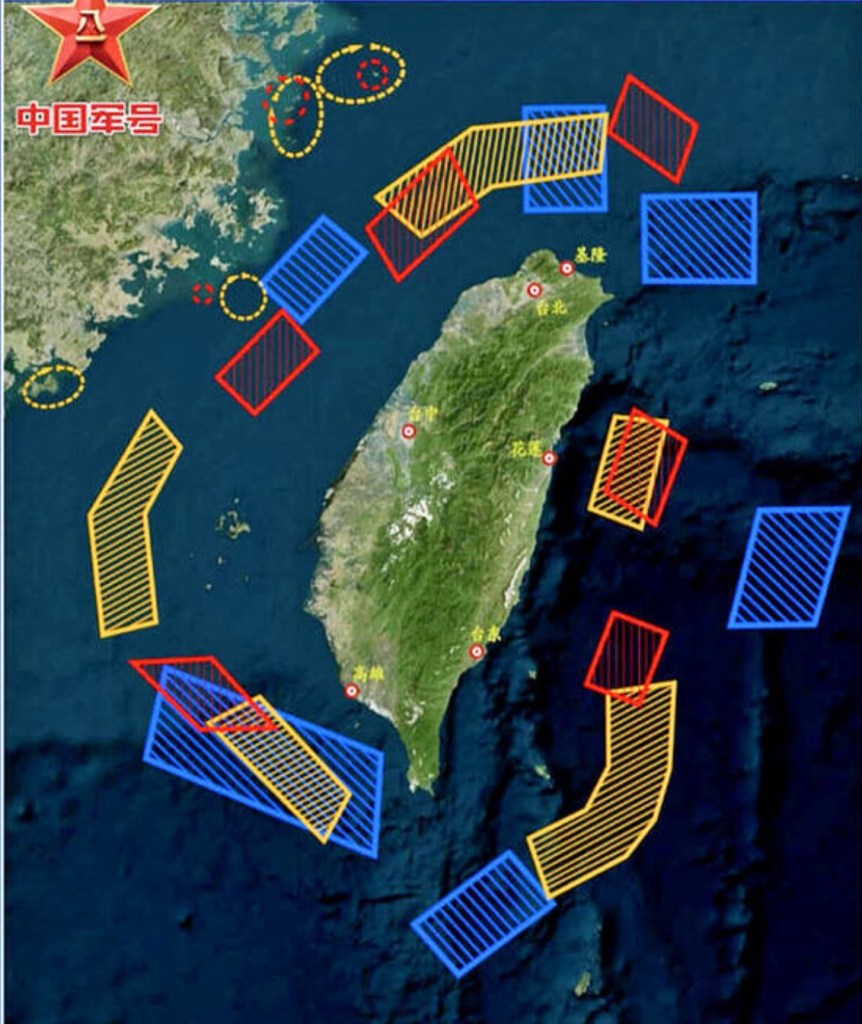
Large-scale military drills have punctuated this pattern of pressure. Notably, in August 2022 after a high-profile visit to Taipei by U.S. House Speaker Nancy Pelosi, China staged unprecedented exercises effectively encircling Taiwan – firing missiles over the island (some landing in Japan’s EEZ) and simulating a naval blockade . In April 2023, during Taiwan’s President Tsai Ing-wen’s transit visit in the U.S., the PLA’s “Joint Sword” exercise again featured a symbolic encirclement of Taiwan and simulated strikes on key targets . More recently, the PLA conducted three major exercises in 2024 (in May, October, and December), all of which demonstrated blockade elements. For example, the October drill practiced what PLA officers called a “key port blockade” – openly rehearsing the cutting off of Taiwan’s “maritime lifeline” for food, energy, and trade . Chinese state media quoted PLA experts boasting of the military’s ability to stop Taiwan’s energy imports (like liquefied natural gas) and to severely impact the island’s economy . These exercises involved joint operations by all branches of the PLA and the China Coast Guard, which encircled outlying Taiwan-held islands and even declared exercise zones intruding into Taiwan’s contiguous zone (24 nautical miles from shore) . Foreign observers note that the PLA is demonstrating an improved capacity to “surge forces” and quickly seize control of areas around Taiwan – a necessary prerequisite for enforcing a blockade . In addition to overt military maneuvers, China has engaged in gray-zone actions such as sending drones and even severing undersea cables linking Taiwan to outlying islands (incidents Taipei suspects were caused by Chinese vessels) . Such tactics could be part of a blockade campaign to isolate Taiwan communications.
Despite this escalatory behavior, it is important to note what has not happened: Beijing has so far refrained from actually attempting a sustained blockade or direct attack. A former head of Taiwan’s armed forces, Admiral Lee Hsi-min, points out that the PLA is currently capable of intimidation (daily ADIZ forays), coercion (blockade moves), and even limited punitive strikes – but not yet capable of a full invasion . According to Lee, China hasn’t pulled the trigger on a real blockade because doing so without the ability to follow through with an invasion could backfire if Taiwan refuses to submit . In other words, PLA harassment and drill “encirclements” are meant to wear down Taiwan’s will, but Chinese strategists know an actual blockade would be an act of war that risks international intervention and a fight they might not yet win. U.S. intelligence assessments reportedly judge that President Xi Jinping has set 2027 as a deadline for the PLA to attain the capability to invade Taiwan . This suggests Beijing’s short-term strategy (for the next couple of years) is to ramp up pressure short of open war, hoping to coerce and demoralize Taiwan without triggering a wider conflict.
Image: A Chinese H-6 strategic bomber flying near Taiwan during PLA “Joint Sword” drills in April 2023 . Record numbers of Chinese warplanes, including bombers and fighters, have been encircling Taiwan’s airspace as part of Beijing’s coercive campaign.
Beijing’s Political Rhetoric and Intentions
Official statements from Chinese leadership underscore an unwavering — and at times ominous — resolve to bring Taiwan under Beijing’s control. President Xi Jinping has repeatedly declared that “reunification” with Taiwan is inevitable and part of the “great rejuvenation” of the Chinese nation. In his New Year’s address as 2024 began, Xi struck a hardline tone, calling unification a “historical inevitability” and warning that no one can stop it . He also reminded the world that China “has never renounced the use of force” regarding Taiwan . By early 2025, Xi was still emphatically vowing that Taiwan “will surely be reunified” with the mainland – by force if necessary, as he reiterated in his 2025 New Year speech . Such rhetoric is not mere nationalism for domestic consumption; it signals to Taiwan, the United States, and China’s own military that Xi’s patience is not unlimited. He has explicitly framed Taiwan’s status as a core interest, even a sacred duty, implying that time is running out on peaceful approaches.
Other Chinese officials have amplified the aggressive messaging. In February 2025, China’s Ministry of Defense spokesperson Wu Qian issued a chilling warning to Taipei’s government: “We will come and get you, sooner or later.” This threat, delivered in response to Taiwan expanding its defensive military drills, left little to the imagination. It equated Taiwan’s efforts to strengthen its defenses with “overreaching” and promised that the pro-independence Democratic Progressive Party (DPP) authorities would meet “self-destruction” . Beijing’s Taiwan Affairs Office similarly labels any pro-Taiwan sovereignty politicians as “separatists” and routinely vows to “take all necessary measures” to thwart what it views as moves toward independence . In Chinese Communist Party doctrine, even the current de facto independence of Taiwan is unacceptable and attributed to “foreign forces” (chiefly the U.S.) instigating separatism. China’s 2022 Taiwan policy white paper and statements around the 20th Party Congress that year all reaffirm that Beijing seeks peaceful unification but will not rule out force against “Taiwan independence forces” or external interference. The upshot of Beijing’s rhetoric is a stark deterrent message: Taiwan must not declare formal independence or deepen ties with foreign powers, or else face war. At the same time, this rhetoric aims to sway domestic public opinion in China to accept the costs of a future confrontation by framing it as an unavoidable part of national destiny.
It’s worth noting that Beijing’s propaganda and diplomatic efforts also seek to shape the narrative short of war. Chinese officials often combine threats with promises that reunification will bring prosperity, and they blame Taipei and Washington for provoking tensions. Still, the tone from the top in Beijing has grown more strident under Xi. His personal consolidation of power and emphasis on achieving the “China Dream” under CCP rule have elevated Taiwan’s unification to a legacy issue for him. Many analysts interpret Xi’s directives – like the 2027 PLA readiness goal – as evidence that he is willing to consider military options on a future timetable . In the immediate term, however, Beijing appears to be pursuing a strategy of intense coercion short of outright war, hoping to intimidate Taiwan into political concessions. The PLA’s former Eastern Theater Commander described this as an “anaconda strategy” – slowly squeezing Taiwan via military, economic, and diplomatic pressure to force capitulation without a direct attack . A blockade, in theory, fits into the “coercive” tactics category, as a step more severe than psychological pressure but short of a full invasion . Beijing’s public statements have not explicitly announced any impending blockade, but the steady drumbeat of threats and the normalization of PLA drills lay a rhetorical groundwork where China could claim it was “forced” to take stronger measures if it perceives Taiwan crossing red lines.
Taiwan’s Response: Political Resolve and Military Preparedness
Taiwan has responded to China’s pressure with a mix of measured defiance and practical preparations. Politically, Taipei’s leadership continues to reject Beijing’s demands for unification under “One Country, Two Systems.” In January 2024, Taiwan’s voters elected Vice President Lai Ching-te as president, representing the DPP, which Beijing views as “pro-independence.” Despite intensified Chinese military coercion and warnings, the Taiwanese public did not swing to the more China-friendly opposition – a sign that years of intimidation have not cowed Taiwan’s electorate. In his inaugural National Day address in October 2024, President William Lai bluntly stated that the People’s Republic of China has “no right to represent Taiwan,” reiterating that each side of the strait is “not subordinate to each other.” This principled stance underscores Taiwan’s refusal to accept Beijing’s sovereignty claims, even as it stops short of declaring formal independence. Taiwan’s leaders have instead sought to strengthen international partnerships (within the limits of the island’s unofficial diplomatic status) and to rally domestic unity around the concept of self-defense. Public opinion in Taiwan overwhelmingly favors maintaining the island’s democratic self-governance; only a tiny fraction of Taiwanese (just ~1–7%) express any desire for unification with China on Beijing’s terms . This social consensus gives the government a mandate to bolster defenses, even if it provokes Beijing’s ire.
On the military front, Taiwan has been boosting its preparedness in anticipation of potential Chinese aggression. A significant move has been the extension of compulsory military service from 4 months to 1 year starting in 2024, reversing a prior downsizing of conscription . Announcing this change, former President Tsai Ing-wen explicitly cited the “rising threat” from China, noting almost daily PLA incursions and the need for Taiwan to be “strong enough” to deter war . The first cohorts of young conscripts began the longer service this year, undergoing more rigorous training (including drills modelled on U.S. military instruction and practice with Stinger anti-aircraft and anti-tank missiles) . Taipei is also increasing its defense budgets substantially. Annual defense spending rose from roughly US $11 billion in 2016 to $19 billion in 2024, and the new administration has pledged to reach over 3% of GDP on defense . This money is going into acquiring advanced systems (like new F-16V fighter jets, air defense missiles, and naval vessels), building indigenous capabilities (such as a new class of diesel-electric submarines to threaten Chinese ships), and improving readiness of reserves and civil defense. In mid-2025, President Lai convened a high-level security meeting and vowed to “strengthen resolve for self-defense and bolster defense capabilities”, signaling continuity in fortifying Taiwan’s deterrence .
Taiwan’s military doctrine has increasingly embraced asymmetric defense – the so-called “porcupine strategy.” Rather than trying to match China tank-for-tank or jet-for-jet (an impossible task), Taiwan is investing in large numbers of mobile anti-ship missiles, coastal mines, fast attack craft, and air defenses that could make a blockade or invasion as costly as possible for the PLA. Regular annual exercises, such as the Han Kuang war games, have been expanded in scope to test responses to PLA attacks. Taiwan’s 2024 Han Kuang exercise included simulating responses to a blockade scenario, and in 2025 these drills are set to be even larger. Taipei is also planning for the civilian aspects of resilience. In late 2024, the government detailed contingency plans to withstand a potential Chinese blockade: stockpiling at least 3–7 months of critical food staples like rice, securing fuel supplies, and setting up mechanisms for rationing if needed . Ministries have been ordered to ensure essential goods are distributed in dispersed storage across the island (to avoid single points of failure) . For example, Taiwan increased its natural gas storage capacity and is establishing new receiving terminals to extend gas reserves from 8 days to at least 14+ days of supply . Plans are in place to convert some civilian farmland to growing staple crops and to use inland fish ponds for food protein if sea fishing is cut off . These actions show that Taiwan takes the threat of a blockade seriously and is moving to mitigate its vulnerabilities. While such measures cannot fully neutralize the impact of a PLA blockade, they would buy Taiwan time and demonstrate to Beijing that a quick “strangle” is not guaranteed.
Importantly, Taiwan’s strategy is not to provoke a conflict, but to deter one by convincing Beijing that Taiwan can endure and resist. President Tsai encapsulated this by saying “Taiwan wants peace but needs to be able to defend itself” . Taipei has been careful not to declare independence or cross China’s red lines, even as it asserts its democratic identity. In practical terms, this means Taiwan continues to posture itself as a status quo power – it does not seek a fight, but it is preparing to ensure any Chinese attack (including a blockade) would fail. The resolve of Taiwan’s 23 million people is a critical factor: years of living under China’s military shadow have fostered a spirit of resilience. The public’s strong support for defending the island’s autonomy, even under threat, suggests China cannot easily coerce Taiwan into surrender through pressure alone. This reduces the chances that a brief blockade or show of force would cause Taiwan’s government to fold. However, Taiwan’s leaders are well aware of the immense challenges they face, and they consistently urge support from international partners to help share the burden of Taiwan’s defense and deterrence.
U.S. and Allied Actions: Diplomatic Support and Military Posture
The United States and its allies have responded to rising cross-strait tensions with increased diplomatic support for Taiwan, enhanced military presence in the region, and warnings to Beijing against unilateral aggression. Diplomatically, while most countries (including the U.S.) do not formally recognize Taiwan as an independent state, there has been a notable uptick in engagement with the island within the one-China policy framework. High-profile visits and contacts send a signal to Beijing. In August 2022, U.S. Speaker Nancy Pelosi’s visit to Taipei (the first by someone of her rank in 25 years) was a visible show of support, prompting Beijing’s furious response. Since then, other delegations of lawmakers from the U.S., Europe, and allied nations have made trips to Taiwan, underscoring a widening international concern for Taiwan’s situation. In 2023, the speaker of Taiwan’s legislature was hosted in many Western capitals, and President Tsai Ing-wen met with U.S. House Speaker Kevin McCarthy during a stopover in California – another symbolic affirmation of ties. Statements from U.S. President Joe Biden have also sharpened recently: on several occasions, Biden said the U.S. would defend Taiwan if it were attacked (though the official U.S. stance of “strategic ambiguity” remains, these remarks have been read in Beijing as stronger deterrent warnings). U.S. allies like Japan, Australia, and European G7 members now regularly mention the importance of peace in the Taiwan Strait in joint statements . For instance, the G7 leaders’ communiqués in 2023 and 2024 emphasized stability across the strait and opposition to any coercive changes to the status quo. This diplomatic chorus signals to Beijing that an attempted blockade or attack on Taiwan would leave China internationally isolated and condemned.
Militarily, the United States has been positioning itself and its allies to respond more robustly to a Taiwan contingency. The U.S. Navy conducts regular Freedom of Navigation Operations (FONOPs) through the Taiwan Strait, asserting it as international waters despite Chinese objections. These transits by U.S. warships (sometimes joined by British, Canadian, or Australian vessels) have increased in frequency, meant to contest China’s attempts to intimidate Taiwan and claim the strait as its zone. The U.S. Indo-Pacific Command has also adjusted force posture: rotational deployments of U.S. Marine and Army units to nearby strategic locations (like the first new U.S. military access sites in the Philippines under the Enhanced Defense Cooperation Agreement) are aimed at improving response times to a Taiwan crisis. Japan, arguably the U.S.’s most crucial regional ally, has dramatically ramped up its defense readiness in the Nansei (Ryukyu) island chain which lies just east of Taiwan. Tokyo’s latest defense strategy explicitly names stability in Taiwan as vital to Japan’s security, and Japan is deploying anti-ship missile batteries and air defense units on islands such as Yonaguni and Ishigaki, which are only a few hundred kilometers from Taiwan. Japanese leaders have said that a “Taiwan emergency” would be considered a “Japan emergency” – a strong hint that Japan could actively support U.S. operations to assist Taiwan if conflict erupts . In late 2023, the Japanese and U.S. militaries reportedly even simulated a joint command exercise with China as the hypothetical adversary in a Taiwan scenario , reflecting the deepening coordination. Australia, too, has signaled its alignment; the AUKUS pact (with the U.S. and UK) to deploy nuclear-powered submarines in the Indo-Pacific and Australia’s own defense review both cite challenges posed by China. Exercises involving multiple allies – for example, U.S.-Japan-Philippines Coast Guard drills or multilateral naval exercises in the South China Sea – serve as practice for coalition responses to regional crises, including a blockade scenario .
Economically, the U.S. and partners are trying to reduce the leverage Beijing could gain in a Taiwan crisis and to raise the prospective costs for China. One facet is the effort to diversify and secure supply chains, particularly for semiconductors (discussed further below). The U.S. CHIPS Act and collaborative initiatives with Taiwan, Japan, and South Korea aim to expand chip production outside of Taiwan over time, which would mitigate the global shock of a Taiwan blockade. Another facet is planning severe economic sanctions to deter Chinese aggression. While not formalized in public, U.S. officials have quietly made clear (and China’s leadership surely understands) that an invasion or blockade of Taiwan would likely result in far-reaching sanctions on China’s economy, similar to or exceeding those imposed on Russia after its Ukraine invasion. This could include cutting China off from critical technologies, freezing assets, and restricting energy imports. The mere possibility of such sanctions is a powerful economic deterrent given China’s integration in world trade. Allied countries in Europe have begun screening outbound investment in sensitive sectors tied to China’s military advancement, and key semiconductor equipment exporters (the Netherlands, Japan, etc.) have joined the U.S. in tightening export controls on chip technology to China. All these measures telegraph to Beijing that its military adventurism will come at a high price. At the same time, the U.S. continues to bolster Taiwan’s own capabilities: foreign military sales to Taiwan (such as advanced missiles and surveillance systems) have been approved at an unprecedented pace – about $26 billion in U.S. arms to Taiwan in the past eight years . Although a backlog in deliveries exists for some big-ticket items (like fighter jets and air defenses), steps like direct drawdowns from U.S. stockpiles (implemented in 2023 for the first time) are being taken to get Taiwan critical munitions faster. Training and exchanges have also quietly expanded; a small contingent of U.S. military instructors is reportedly in Taiwan helping train its forces in irregular warfare and joint operations, and Taiwanese troops have attended exercises and schooling in the U.S. and Japan.
In summary, the international environment is increasingly unfavorable for any Chinese blockade gambit. The United States and allies are diplomatically rallying around Taiwan and militarily preparing to counter or bust a blockade if one were attempted. U.S. Navy officials have openly stated that they would consider a Chinese blockade an unacceptable attempt to change the status quo by force, likely necessitating action such as escorting ships into Taiwan or clearing blockading forces. Indeed, polls of foreign policy experts show a strong consensus in Washington and Taipei that the U.S. Navy would intervene to break a blockade, even at risk of war . Knowing this, Chinese planners must consider that a blockade could quickly escalate into a direct conflict with the U.S. and allied coalition – a scenario China would not take lightly, especially before it believes the PLA has full military superiority in the region. This international resolve and coordination are key political indicators reducing the near-term likelihood of a blockade, since China prefers to isolate Taiwan, not unify the world against itself.
Economic Interdependencies and the Semiconductor Factor
The economic stakes of a Taiwan crisis – for China, the region, and the world – are enormous. Taiwan is tightly woven into the global economy, and any blockade would disrupt critical supply chains, especially for high-tech components. In particular, Taiwan’s dominance in the semiconductor industry acts as both a potential leverage point and a deterrent in the strategic calculus. Taiwan manufactures over 60% of the world’s semiconductors and around 90% of the most advanced chips . These chips (produced mainly by TSMC, Taiwan’s flagship foundry) are essential for everything from smartphones and PCs to automobiles, medical devices, and military hardware. The world’s tech giants (Apple, Nvidia, Qualcomm, etc.) rely on uninterrupted shipments from Taiwan’s chip fabs. Even China’s own tech sector depends heavily on Taiwanese chips for assembling electronics – ironic but true, China imports more than $300 billion in chips annually, many of which come from or pass through Taiwan. A Chinese blockade halting exports from Taiwan would choke off this semiconductor supply, causing cascading economic damage far beyond Taiwan’s borders. Analysts estimate that a sudden loss of Taiwanese chips would plunge global electronics production into crisis, leading to severe shortages and inflation in technology products worldwide . Industries like automotive manufacturing (already sensitive to chip shortages) could grind to a halt in many countries. The global economic shock of a Taiwan blockade or war has been estimated in the trillions of dollars, potentially crippling growth in China, the U.S., and Europe alike .
From China’s perspective, Taiwan’s semiconductor might is sometimes called a “silicon shield.” The idea is that Taiwan’s pivotal role in the global economy gives major powers (especially the U.S. and Japan) a compelling incentive to intervene to protect Taiwan, and conversely, it gives Beijing reason to hesitate before risking catastrophic damage to an industry it also needs. Beijing is acutely aware that if it were to seize or blockade Taiwan, it would likely face not only military pushback but also long-term economic estrangement; China would be viewed as a global pariah unsafe for business, much like Russia after invading Ukraine, only with far larger consequences. At the same time, Chinese strategists might covet Taiwan’s semiconductor sector as a prize – control of TSMC’s fabs could theoretically give China a near-monopoly in advanced chipmaking (though in practice, those complex facilities and talent might not function under wartime conditions or if key personnel flee). In any event, the semiconductor supply chain is a central economic factor in evaluating blockade likelihood. Regional economies are deeply intertwined: Japan and South Korea, for example, not only depend on chips from Taiwan but also supply crucial materials and equipment to Taiwan’s fabs. A blockade would force these neighbors to take sides quickly, since their own industries would suffer. Similarly, about 88% of the largest container ships in the world by tonnage pass through the broader South China Sea region each year, many through the Taiwan Strait; a blockage there would disrupt shipping routes between Northeast Asia and the rest of the world. Energy supplies could also be affected, as significant volumes of liquefied natural gas (LNG) bound for Taiwan, Japan, and South Korea transit near Taiwan. In fact, Taiwan imports over 70% of its oil from the Middle East and most of its LNG from abroad , all via maritime routes that China could attempt to cut. This high dependence is why Taiwan has worked to diversify suppliers and keep strategic petroleum reserves, but a concerted blockade would still imperil its energy security.
For China, a blockade would also mean self-inflicted economic wounds. Taiwan is one of China’s largest trading partners; Chinese and Taiwanese companies are interconnected through supply chains (especially in electronics assembly, where components flow back and forth). If Beijing strangled Taiwan’s economy, Chinese manufacturers would lose orders and inputs, and millions of Chinese jobs could be affected. Moreover, the global financial reaction to aggression could see foreign investors pull capital from China en masse, destabilizing markets. Beijing’s leadership, which places great emphasis on domestic economic stability and the Chinese Communist Party’s performance legitimacy, must weigh these economic risks heavily. The current signals suggest China is trying to reduce its vulnerabilities (for example, stockpiling grain, expanding its own chip industry, and promoting yuan trade to prepare for sanction scenarios), but within the next 1–2 years it cannot insulate itself from the shock of a Taiwan conflict. The semiconductor dependence alone is an unsolved issue; China’s efforts to build an indigenous 7nm-and-below chipmaking capability are still lagging years behind Taiwan’s.
In summary, the economic interdependencies serve as a powerful brake on reckless action. Any Chinese decision to initiate a blockade would have to account for immediate global supply chain disruption and likely unified economic retaliation by the U.S., EU, Japan, and others. Politically, Xi Jinping certainly prioritizes unification, but not at the cost of destroying China’s economic future unless he felt no other choice. The next couple of years are a period when the world (and China itself) remains highly reliant on a peaceful and open Taiwan Strait for economic stability. This makes a deliberate blockade less likely unless Beijing feels cornered or extraordinarily confident it can weather the fallout.
Expert Assessments of Blockade Risks
Strategists and military analysts have debated the scenario of a Chinese blockade of Taiwan, and their assessments provide important context. A number of experts have pointed out that Beijing might favor a blockade or “quarantine” approach over an outright invasion as a way to coerce Taiwan into submission without the massive casualties of a beach assault . This view gained traction in 2023, when multiple analysts argued that the most acute threat facing Taiwan could be a gradual strangulation of its economy and isolation from the world, rather than a sudden D-Day style invasion . In Taiwan itself, some officials echo this concern; Deputy Foreign Minister Roy Lee said he believed China is “more likely to execute an economic blockade of Taiwan” than to launch a direct attack, given Beijing’s hope to “win the war without an actual fight.” . Taipei’s national security community has in turn focused planning on countering a blockade, as evidenced by the food/fuel stockpiles and the diplomatic push for support mentioned earlier. Think tanks like the Atlantic Council have published detailed simulations of a PLA naval blockade, calling it “the most strategically viable action for the PRC” short of full invasion, especially because Taiwan is uniquely vulnerable as an island reliant on imports . These studies emphasize that a blockade, even a limited or partial one (such as a “customs quarantine” where Chinese ships inspect and turn back vessels), would pose a serious challenge for Taiwan and could test the resolve of the international community.
However, not all experts agree that a blockade would achieve China’s aims. A comprehensive analysis by a U.S. war-gaming expert in mid-2024 concluded that an attempted economic blockade would likely fail to break Taiwan’s will and would almost certainly escalate into a wider war – an outcome Beijing wants to avoid . The reasoning is that Taiwan has some capacity to resist a blockade, and its people are unlikely to capitulate simply from economic pain, especially if they know help may be on the way. Meanwhile, a blockade is an act of war that would invite U.S.-led military intervention to keep sea lanes open. In this view, China gains little by a blockade unless it is fully prepared to fight and win the ensuing conflict. As one analyst put it, a blockade would either “fail or launch a war,” making it a low-success, high-risk strategy . Significantly, despite the PLA’s growing capabilities, China has not attempted anything as risky as a blockade to date – even though, technically, the PLA Navy has had the means to at least threaten maritime traffic for years. This restraint suggests that Beijing also perceives a blockade as likely to trigger outcomes (like direct U.S. military involvement or harsh sanctions) that it is not ready to face. Admiral Lee Hsi-min’s perspective aligns with this: partial measures like blockade make little strategic sense unless China is truly ready to invade and force unification, because otherwise Taiwan and its partners would simply hold out .
Many Western think tanks (RAND, CSIS, etc.) have conducted war games or issued reports on a Taiwan conflict. A consistent finding is that time is a crucial factor. A quick, surprise move might catch defenders off guard, but a protracted conflict favors Taiwan if allies support it. A blockade, by its nature, is a slow squeeze, giving time for international reaction and coalition-building. This would not remain a local issue for long. Additionally, Chinese leadership has internal considerations – Xi Jinping has accumulated power and silenced dissent, but a military adventure gone wrong (stalemated or countered by foreign intervention) could endanger the Communist Party’s domestic standing. Thus, some experts assess the near-term risk of an all-out crisis as relatively low unless Beijing feels provoked by a major political shift (like a formal Taiwanese independence declaration, which Taiwan’s government has avoided). Notably, U.S. intelligence and defense officials have pegged the later 2020s as a potentially more dangerous window, when the PLA’s modernization (including new aircraft carriers, hypersonic missiles, and amphibious lift) might give China more confidence in military options . In contrast, 2025–2026 is seen by many analysts as a period in which China will continue aggressive posturing and “dress rehearsals” (exercises/blockade simulations), but is unlikely to initiate a full blockade barring an unforeseen crisis. The Institute for the Study of War’s recent updates also indicate that current Chinese activities (e.g. espionage, gray-zone incursions) are designed to weaken Taiwan’s readiness and morale over time, rather than trigger an immediate confrontation .
To be clear, the risk of miscalculation remains. With so many Chinese aircraft and ships operating around Taiwan on a daily basis, the chance of an accident or an overzealous local commander causing an incident is real. A collision or exchange of fire could escalate unexpectedly. Both sides have protocols to avoid this, but the potential for inadvertent escalation is an ever-present wildcard. Experts warn that even if neither Beijing nor Taipei (nor Washington) wants a war now, a spiral of tit-for-tat actions could create its own momentum. For example, if China declared some form of air or naval exclusion zone around Taiwan in the coming year (perhaps as a response to a perceived political slight), and then tried to enforce it, that could rapidly cross into blockade territory. Such a scenario would test each side’s resolve and could become a flashpoint. Think tanks have urged all parties to improve crisis communications and to clearly signal red lines to reduce this risk . Taiwan’s government, for its part, carefully calibrates its actions to avoid giving China a pretext. The newly elected President Lai has reassured that he will maintain cross-strait stability and not provoke Beijing, even as he refuses CCP demands.
In weighing expert views, it seems most converge on this point: a deliberate, large-scale blockade initiated by Beijing in the next year or two is possible but not probable. It remains more likely that China will continue intense military pressure short of war, hoping to wear Taiwan down or influence its politics (for instance, trying to sway public sentiment against the DPP or deter other countries from supporting Taiwan). A sudden blockade would be a dramatic escalation that locks China into a confrontational path with the U.S. and its allies – a decision not taken lightly. Of course, intelligence assessments could change if, say, China’s internal timeline accelerates or if Chinese leaders perceive the strategic environment shifting in their favor (or conversely, if they feel a closing window of opportunity). That is why Taiwan and the U.S. remain vigilant and prepare for worst-case scenarios even as they assess the likelihood as moderate or low in the immediate term.
Conclusion: Near-Term Outlook and Synthesis
Considering the political, military, and economic indicators discussed, the likelihood of China initiating a full blockade of Taiwan in the next 1–2 years appears relatively low – but the situation is volatile. Beijing is undoubtedly ratcheting up pressure on Taiwan through unprecedented military activities and vitriolic rhetoric, demonstrating the capability and intent to eventually cut off the island. However, a blockade is tantamount to an act of war, and current signs suggest China is not yet prepared to bear the escalatory consequences. The PLA is still in the process of achieving the joint force prowess it would want before taking such a plunge (targeting a 2027 goal for invasion capability ). Moreover, China faces powerful disincentives in the political-economic realm: a premature attack on Taiwan would likely unify the United States, Japan, and many others in opposition, potentially crippling China’s trade and technological access at a time when its economy has been slowing. The “gray-zone” campaign Beijing now wages – constant patrols, drills, diplomatic isolation of Taiwan – arguably serves its aims at lower cost, so long as Taiwan does not slip toward formal independence. Indeed, from Beijing’s perspective the current strategy has had some success in wearing down Taiwan’s readiness and deterring de jure independence (Taipei has not made irreversible moves toward statehood, partly due to the looming threat) .
That said, the risk of miscalculation or sudden crisis cannot be dismissed. Xi Jinping’s government has tied Taiwan to nationalist legitimacy, and unexpected triggers (an internal Chinese crisis, a provocative political move in Taipei, or even a hardline turn in U.S. policy) could prompt China to take drastic action. Short of an all-out blockade, we might see intermediate steps in the coming two years: for example, China could declare “no-fly/no-sail zones” for extended periods under the guise of military exercises, or start interdicting select ships bound for Taiwan under a flimsy legal pretext (a de facto quarantine). These actions would test international response and might be used by Beijing to incrementally squeeze Taiwan. So far, whenever China has escalated militarily, the U.S. and its allies have answered with their own shows of support, and Taiwan has stood firm. This dynamic resembles a dangerous equilibrium – one where neither side wants war, but both are preparing for it.
In pure probabilistic terms, most experts would assess the chance of a major Chinese blockade or attack on Taiwan in 2025–2026 as low-to-moderate (certainly well below 50% in any given year). The consensus view is that deterrence is holding for now, albeit under strain. Political and economic indicators support this: Beijing’s focus seems to be on long-term leverage (military modernization, economic self-reliance) while pressuring Taiwan in the interim; Taiwan is bolstering defenses and has the explicit backing of the U.S. alliance network. Global economic dependencies – especially the semiconductor supply chain – act as a stabilizing factor because they raise the cost of conflict for all sides. However, “low likelihood” is not “no likelihood.” The situation remains one of the most perilous flashpoints in the world. Both Beijing and Washington are intensely monitoring each other’s intentions.
Over the next two years, it is most likely we will see continued Chinese military posturing and political saber-rattling around Taiwan rather than an outright blockade. PLA aircraft and ships will keep probing Taiwan’s defenses, perhaps in even larger numbers , and Beijing will continue trying to erode Taipei’s international space. Taiwan, for its part, will keep enhancing its “porcupine” defenses and seeking stronger security ties with the U.S., Japan, and others. This could further anger Beijing but also raise the deterrent threshold. The United States and allies will strive to maintain a credible forward presence to discourage any Chinese misadventure. All parties will be carefully calibrated, because a misstep could be calamitous.
In conclusion, a Chinese blockade of Taiwan in the immediate future is not imminent given the current political and economic climate, but the possibility cannot be entirely ruled out. The groundwork for such a scenario is being laid in PLA capabilities and propaganda, even if the actual execution may be held in abeyance until Chinese leaders judge the odds to be in their favor. Policymakers and analysts must therefore watch for shifts in those indicators – such as a sudden change in Chinese rhetoric towards urgency, an accelerated PLA buildup, or a collapse in deterrence signaling – that could portend a change in the likelihood. As of now, Beijing appears to calculate that time is on its side and that outright conflict in the next year or two would be premature. The world, meanwhile, is signaling that aggression against Taiwan would meet a unified and forceful response. This uneasy balance makes a blockade scenario in 2025–2026 a risky gamble for China – one that, for the moment, it is more likely to threaten than to actually undertake .
Sources:
• Davidson, Helen. The Guardian – Analysis of PLA military harassment and Xi’s reunification vows .
• Global Taiwan Institute – Reports on Chinese drills (Joint Sword exercises) simulating encirclement and blockade .
• Reuters – Xi Jinping’s statements on Taiwan reunification and Taiwan’s extended conscription policy .
• Taipei Times/Reuters – Details of PLA exercises in Oct 2024 practicing port blockades and involving Coast Guard .
• Voice of America – Taiwan’s contingency plans for a potential blockade (food, energy stockpiles) .
• War on the Rocks – Expert assessment arguing a blockade would likely fail or spark war, hence Beijing’s hesitance so far .
• Atlantic Council – Strategy paper describing a blockade as a viable but enduring threat and calling for allied preparedness .
• Focus Taiwan (CNA) – Taiwan’s defense budget increases and President Lai’s pledge for 3% GDP defense spending .
• The Guardian – Chinese Defense Ministry threat (“we will come and get you”) in Feb 2025 and semiconductor industry importance .
• Additional sources from CSIS, CFR, and others on military trends and economic impacts .
 Dr Bob, Brain Mechanic