
After much thought, I’ve decided to leave Substack. It’s not a decision I’ve taken lightly, but over time, the limitations of the platform—and the values it represents—have made it clear that it’s no longer the right fit.
Substack prides itself on being a platform that champions “free speech,” but in practice, that’s meant tolerating and profiting from voices that spread disinformation, bigotry, and extremism. The company’s refusal to take a firmer stance against this content—even as it benefits from the subscriptions it enables—creates a troubling dynamic. Supporting Substack, even indirectly, means participating in that ecosystem.
Beyond content moderation, there are technical and strategic reasons I’m moving on. Substack offers very little control over design, branding, or the reader experience. It’s easy to get started, yes, but difficult to grow meaningfully or differentiate as a creator. Its discovery tools are weak unless you’re in their internal network, and the 10% fee it takes from all earnings becomes increasingly painful as your audience grows.
Most importantly, I don’t want to build on rented land. On Substack, your content lives on their servers. Your relationship with your audience depends on their infrastructure. If the company changes direction—or collapses—you’re left exposed. That’s not a sustainable model for long-term creative independence.
So I’m moving to WordPress (for now)
⸻
My Analysis of Other Platforms
1. Ghost
Why:
* Fully open-source and self-hostable
* Better customization and design control
* Native membership and subscription features without high fees
* No algorithmic feeds—readers get everything you publish
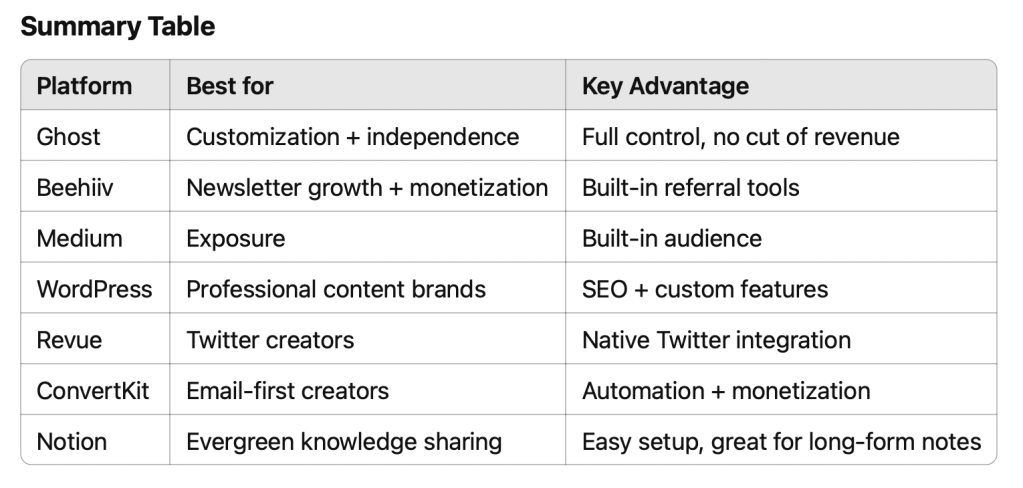
Best for: Writers who want full ownership and control without platform constraints.
⸻
2. Beehiiv
Why:
* Built-in referral programs and growth tools
* Native support for newsletters and blogs
* Designed for monetization, analytics, and segmentation
* More affordable at scale than Substack
Best for: Creators focused on newsletter growth and monetization.
⸻
3. Medium
Why:
* Built-in audience via recommendations and curation
* Clean, distraction-free interface
* Monetization via Medium Partner Program
* No need to manage email infrastructure
Best for: Writers who want exposure and a wider built-in audience.
⸻
4. WordPress (with Jetpack or Newsletter plugin)
Why:
* Highly customizable with thousands of themes and plugins
* Own your content and email list
* Easier to integrate multimedia or complex formatting
* Better SEO tools than Substack
Best for: Professionals building a long-term content brand.
⸻
5. Revue (for now, via Twitter/X)
Why:
* Native integration with Twitter/X
* Easy to convert followers into newsletter subscribers
* Simple UI for quick publishing
Best for: Creators with an existing audience on Twitter.
⸻
6. ConvertKit
Why:
* Powerful email automation and segmentation tools
* Focus on creators monetizing their list
* Built-in landing pages and commerce tools
* Less about blogging, more about building creator businesses
Best for: Email-first creators with product or service offerings.
⸻
7. Notion (with Super or Potion to publish)
Why:
* Ideal for knowledge-sharing and evergreen content
* Can be styled into a lightweight blog or digital garden
* Minimal maintenance; easy collaboration
Best for: Thought-leaders or educators sharing evergreen content.
⸻
Conclusion
Since I already have a WordPress account with the neurodoctor.com domain, I’m going to do all my posting there for now (and, of course, on Mastodon 🤗). And looking seriously at Ghost.
See you on the other side.
 Dr Bob, Brain Mechanic