
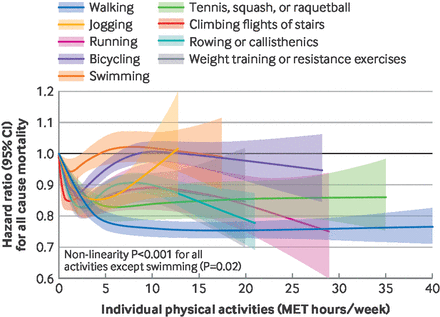
TL:DR Variation in physical activity may be just as important as total activity to promote longevity
This study used long-term data from two large prospective cohort studies, the Nurses’ Health Study and the Health Professionals Follow-Up Study, including over 110,000 adults followed for up to ~30+ years to look at the relationship between types of physical activity, variety of activities, and mortality.
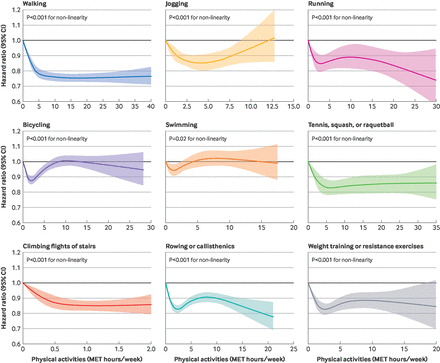
Rather than just measuring total activity, the authors examined individual activities (walking, jogging, running, cycling, tennis/squash, stair climbing, rowing/calisthenics, resistance/weight training) and a variety score based on how many different activities participants consistently did.
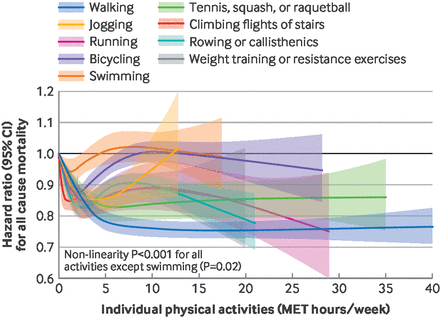
Key findings were:
• Most individual activities (except swimming) were associated with lower all-cause mortality in a non-linear dose-response way: more activity gave more benefit up to a point.
• A higher variety of different physical activities (engaging in multiple types, not just one) was independently linked with lower mortality even after adjusting for overall total activity volume.
• People with both high total activity and high variety had the lowest mortality compared with those low on both.
The results suggest that cross-training or mixing activity types might confer benefits beyond sheer volume of activity.
Strengths
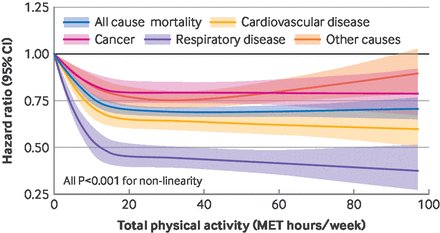
• Huge sample size and long follow-up (over 2.4 million person-years), which increases statistical power and reliability.
• Repeated updates of physical activity over decades reduce bias from single baseline measures.
• Use of established cohorts with validated questionnaires and rich covariate data improves adjustment for confounders.
Limitations
• This is observational, so causality cannot be firmly established. People who do more and varied exercise may differ in unmeasured ways (diet, social determinants, healthcare access) that also affect mortality.
• Physical activity was self-reported, subject to recall error and misclassification.
• The measure of “variety” counts types, but not intensity, duration, or pattern — two people with the same variety score might have very different actual activity profiles.
• Some activities (e.g., swimming) showed weaker or no associations, possibly due to measurement error, lower prevalence, or cohort effects.
Interpretation nuance
The finding that variety adds benefit beyond total activity is intriguing — it parallels what exercise physiology would predict about multi-modal training affecting different systems (cardiorespiratory vs musculoskeletal), but it should not yet be taken as prescriptive evidence that variety itself is mechanistically superior without further trials.
⸻
Overall Take-Home
Engaging in regular physical activity across different types appears linked with lower mortality risk, even beyond simply doing a lot of activity. For public audiences, this supports encouraging both higher overall activity and mixing modalities rather than just focusing on one form (e.g., only walking or only running).
 Dr Bob, Brain Mechanic