
Because the modern world runs on three different layers that don’t talk nicely to each other: technology standards, carrier politics, and Apple’s walled-garden pragmatism.
Let’s untangle it.
First, what RCS actually is.
RCS stands for Rich Communication Services. It’s basically “SMS 2.0.” Instead of old-school 160-character text messages bouncing through carrier SMS servers, RCS uses data, supports typing indicators, read receipts, higher-quality media, and group features. The standard is governed by the GSMA, the global mobile industry association.
In theory, RCS should work anywhere you have data. In practice, it often doesn’t internationally on iPhone for a few reasons:
Carrier-based provisioning Unlike iMessage or WhatsApp, RCS is not purely app-based. It’s provisioned through your mobile carrier. Your number has to be registered for RCS on your home carrier’s network. When you travel internationally and roam onto a foreign carrier, that foreign network may not support RCS interconnect with your home carrier’s RCS system. So the conversation silently falls back to SMS.
RCS was designed as a carrier service first, not an internet service first. That decision haunts it.
Fragmented implementations Most Android RCS globally runs through Google’s Jibe servers, which act as a centralized cloud layer. Apple only recently added RCS support to iOS, and it depends heavily on carrier support rather than Google’s cloud hub.
So if: Your carrier doesn’t have proper international RCS peering agreements, the foreign carrier doesn’t support RCS roaming or the receiving carrier doesn’t interconnect,
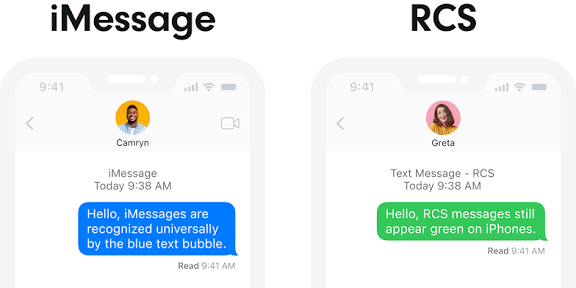
Then no dice. Back to green bubbles.
Roaming complexity: When roaming, your phone technically becomes a guest on another carrier’s network. SMS roaming is ancient and universal. RCS roaming agreements are newer and not universally deployed. Many carriers simply haven’t prioritized it.
Think of it like international banking transfers before SWIFT was universal. The pipes exist, but the handshake agreements aren’t consistent.
Apple’s ecosystem philosophy: Apple’s primary rich messaging solution is iMessage, which is internet-based and global. From Apple’s perspective, international messaging “just works” if both users are on iMessage.
RCS is there mainly for Android interoperability. Apple doesn’t control RCS infrastructure the way it controls iMessage, so it can’t guarantee the experience globally.
Now the irony: WhatsApp, Signal, Telegram all work globally because they bypass carrier infrastructure entirely. They’re pure over-the-internet services.
RCS sits in an awkward middle zone: Modern features built on legacy telecom plumbing.
The result: International iPhone RCS fails when roaming or when carrier interconnect agreements aren’t in place. It’s not your phone. It’s the telecom ecosystem behaving exactly like a 1998 standards committee.
The deeper pattern here is interesting: Technologies controlled by distributed telecom alliances evolve slowly and inconsistently. Technologies controlled by centralized internet platforms move faster and more uniformly. That’s not inherently good or bad — it’s just governance structure expressing itself.
The long-term future? If RCS becomes more cloud-mediated and less carrier-dependent, international reliability will improve. If carriers drag their feet, messaging will continue shifting to pure data apps.
The universe favors the path of least friction. Messaging always migrates toward whichever layer has the fewest gatekeepers.
 Dr Bob, Brain Mechanic