
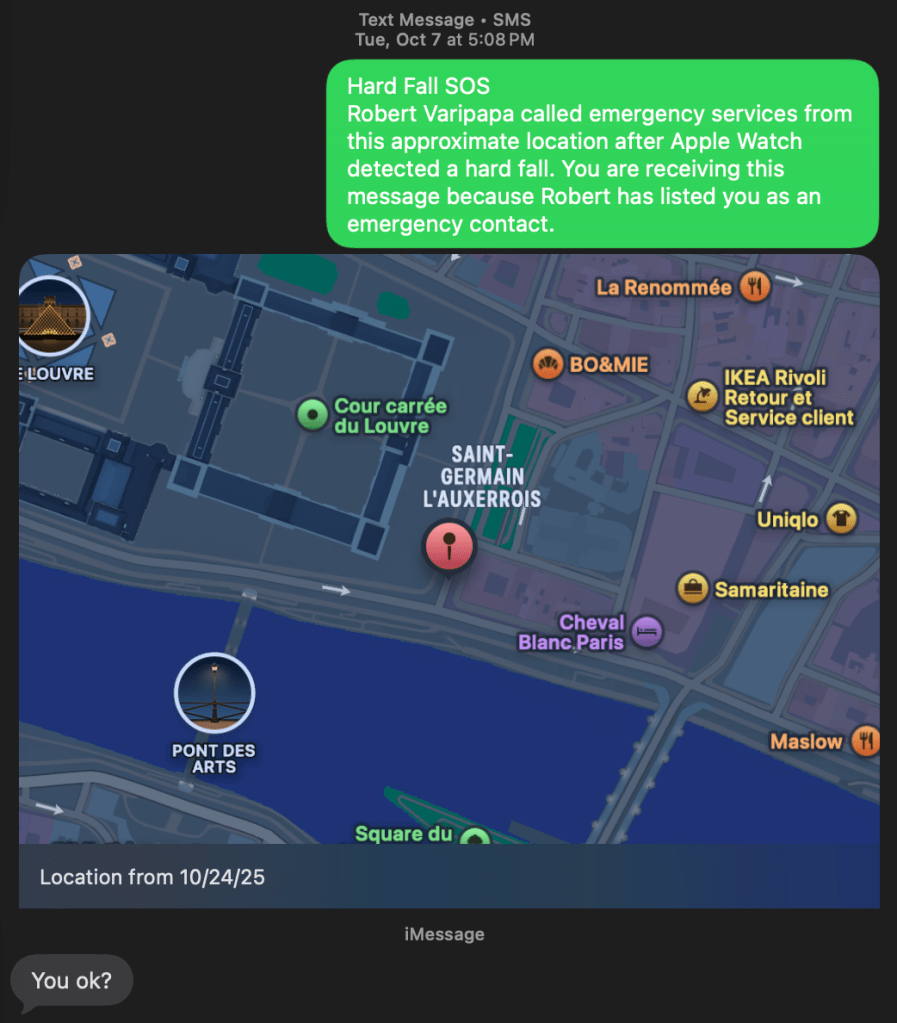
A Split Second in Paris
Crossing a street near the Louvre, I had no time to react before an inebriated Parisian ran a red light and struck me in the pedestrian lane. My Apple Watch immediately detected the impact, sent an SOS message to my three children (my emergency contacts) and summoned an ambulance. I lost consciousness for two hours and woke up in a Paris Emergency Room, neck braced, dazed, and alive.

Five Days in a French Hospital
Imaging confirmed no fractures or brain bleed, but I’d sustained a central cervical spinal cord injury. Painful but survivable, I spent the next five days in a Paris hospital. Hardly the vacation I’d planned! Yet despite the language barrier and disorientation, I was deeply impressed by the efficiency and professionalism of the medical team.
The Bill Arrives
Weeks later, the bill arrived: $8,000 total. That covered an ambulance, a full-body CT scan, four MRI scans, and five days of hospital care.
Had the same accident occurred in the United States, the charges would easily have exceeded $200,000, with itemized bills for every supply and scan, facility fees, and physician charges stacked like bricks.
France vs. the U.S.: Two Philosophies of Care
France runs on a universal, single-payer foundation (Sécurité Sociale), supplemented by affordable private insurance. Prices are tightly regulated by national negotiation, and hospitals, many publicly owned, operate as public services rather than profit centers. Doctors are salaried, administrative overhead is low, and patients know what things cost.
The United States, by contrast, operates a multi-payer, market and profit driven system that values innovation but suffers from fragmentation. Hospitals must navigate a maze of insurers, each with its own rules, networks, and pricing. Administrative costs absorb roughly 25–30% of U.S. health spending. The result: great technology and expertise, but at ruinous personal and national cost.
Reflections from a Neurologist
Lying in that hospital bed, I found myself reflecting on my injuries and the decades working within our health care system. America’s health care excels in acute trauma and complex interventions, does poorly with basic health care and remains financially unsustainable. France reminded me what can happen when healthcare is treated as a public good rather than a profit-based industry.
Gratitude and Perspective
I’m recovering well. My spinal injury continues to improve, and I’ll forever be grateful for the Paris medical team who treated me with skill and kindness. The experience left me with a simple truth: healthcare shouldn’t bankrupt those it saves. Paris may have left me bruised, but it also left me wiser about what compassionate, efficient medicine can look like.
 Dr Bob, Brain Mechanic