
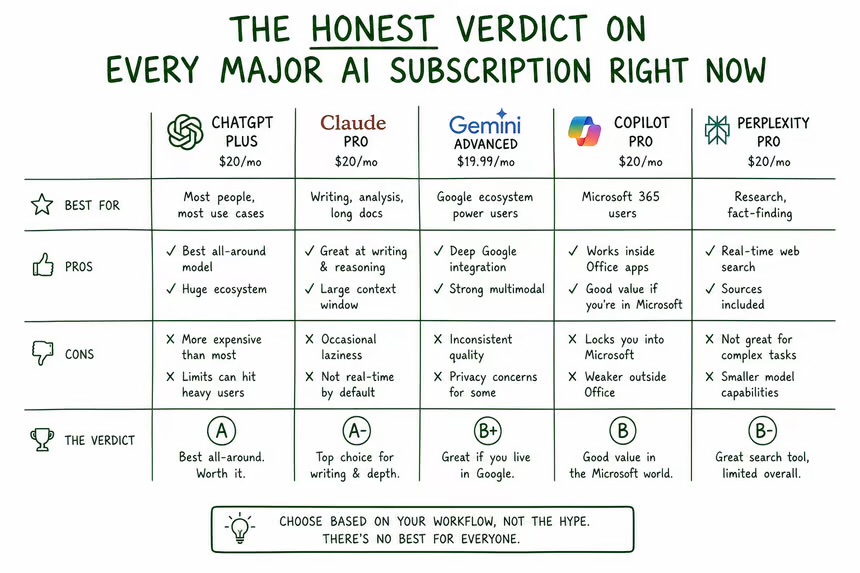
Free AI tiers have quietly gotten very good. Here’s a frank breakdown of which paid subscriptions still earn their cost and which ones don’t.
The AI subscription market has a quiet structural problem. When these products launched, the gap between free and paid was large enough to justify the charge without much thought. That’s changed. Every major platform has improved its free tier in the last year, free users are a growth metric investors reward, and the side effect is that the value case for the $20 paid tier has thinned considerably.
Here is where things actually stand.
ChatGPT Plus — $20/month
Still defensible for heavy daily users. Voice mode, more reliable access during peak hours, larger upload limits, and earlier access to new models are all real advantages. If you open ChatGPT for serious work every day, it earns its cost. If you use it a few times a week for quick questions, the free tier handles it and the $20 is going nowhere.
ChatGPT Pro — $200/month
Almost never worth it for an individual. The o1 Pro mode access and additional compute exist, but the personal use cases that genuinely require that level of compute are rare. If you upgraded because you wanted the best possible version of the product, there’s a good chance you’re not using what you’re paying for.
Claude Pro — $20/month
One of the more defensible subscriptions on this list, but only for a specific reason: Projects. If you use Projects to give Claude persistent context across sessions and you hit the free tier limits regularly, the upgrade pays off in a way you can actually feel. Without that specific workflow, the free tier is strong enough that most occasional users won’t notice the difference.
Gemini Advanced (Google One AI Premium) — $20/month
The hardest to recommend. The model is capable, but the gap between it and the free Gemini tier is thin for most users. The Workspace integration that was supposed to make the value obvious has been slower to materialize than Google suggested at launch. Most people paying for it are paying for a promise that hasn’t fully delivered.
Perplexity Pro — $20/month
The one most people can drop without noticing. The free tier gives you AI-powered search with a daily limit that most casual users never actually hit. If you’re using Perplexity as a dedicated research tool for hours every day, keep it. Otherwise you’re paying for headroom you’re not using.
GitHub Copilot — $10–$19/month
The most underrated subscription on this list. For anyone in their code editor most of the day, it’s the one AI tool that has consistently shown a change in actual output — not just output quality. It earns its cost in a category most comparison articles forget to include.
The Pattern Across All of Them
The subscriptions that justify their cost change the workflow, not just the quality of individual answers. When a paid tier only gives you better responses rather than a different way of working, the free tier is usually close enough that most people wouldn’t miss the upgrade.
Three Things Worth Knowing Before You Decide
Microsoft Copilot Pro hasn’t fully arrived
Copilot Pro integrates AI into Word, Excel, PowerPoint, and Outlook, a clear value proposition on paper. The actual experience has been more limited than the marketing suggested, with uneven quality across apps and features that arrived later than announced. Worth revisiting if you tried it early and gave up, but not the obvious $20 purchase it was positioned as.
Free tiers carry different data terms than paid ones
On a free account at most major AI platforms, your conversations are more likely to be used for model training than on a paid account. The $20/month isn’t just buying more capacity — it’s buying different data handling. Pricing pages aren’t upfront about that distinction, so it’s worth knowing before you decide the free tier is sufficient.
You may already be paying for something you’ve forgotten
Google One AI Premium and Microsoft 365 Copilot are often added as upsells during a billing cycle or activated during a free trial that auto-converted. A meaningful number of people are paying for AI subscriptions they signed up for months ago and forgot. Check your active subscriptions before deciding what to keep.
The Verdict
Most people with more than one AI subscription are overpaying.
The strategy at every major AI platform is the same: keep the free tier good enough to grow the user base, keep the paid tier just differentiated enough to hold the charge, and hope users never sit down and work out whether the upgrade actually changed anything for them.
The people getting clear value from paid AI subscriptions are the ones who hit a specific ceiling, the developer burning through Copilot’s free tier every day, the writer who needs Claude’s Projects to function, the researcher using Perplexity for hours at a stretch. For everyone else, the free tier is closer to sufficient than the pricing page would have you believe.
The Honest Test
Look at what you paid last month across AI tools. Then ask what you specifically could not have done on a free tier. If the answer takes more than one sentence to explain or if it’s vague, that’s your answer.
The most ruthless version of this test: cancel everything, wait two weeks, and only sign back up for the one you actually missed. Most people find they missed one product and had completely forgotten about the other three. The industry calls those three “retained subscribers.” The more accurate word is “overlooked.”
Go check your subscriptions, not just the AI ones, all of them. Look for anything AI-related you didn’t consciously sign up for or haven’t used in 30 days. Then pick one subscription you’re keeping and name in one sentence what it lets you do that the free tier doesn’t. If you can’t, that’s worth knowing.
NB: Source article critiqued and reviewed with the help of Claude

