
Adapted from a Claude AI query
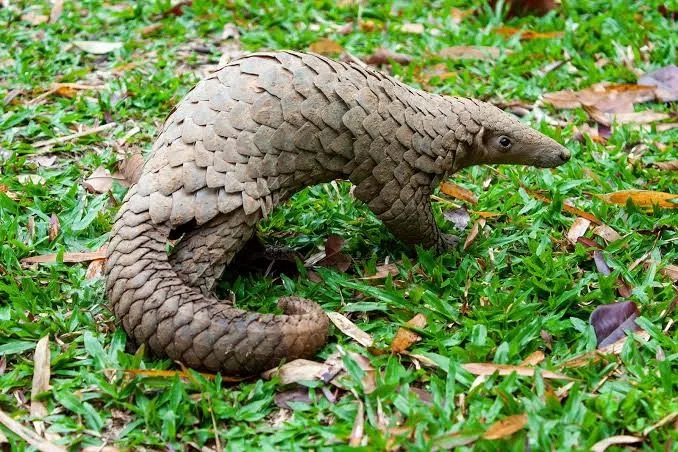
Pangolins are the world’s only truly scaly mammals. Imagine an anteater wearing armor made of the same stuff as your fingernails.
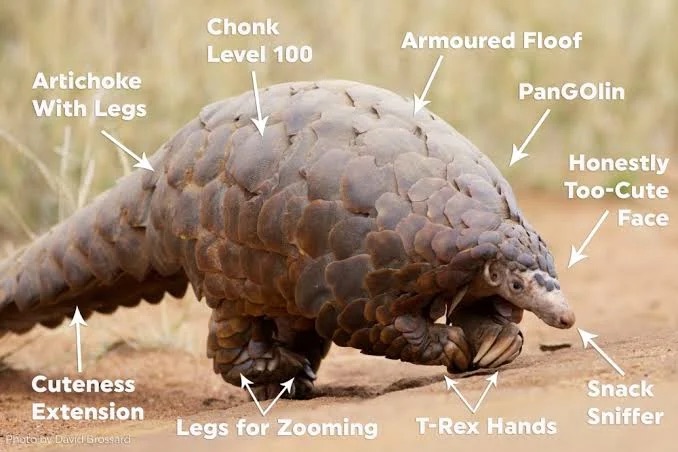
Their whole body is covered in overlapping keratin scales, and when threatened they curl into a tight ball. The name comes from the Malay word pengguling, “one who rolls up.” (Amusingly, that’s close to the “Pengelans” mystery from a moment ago.)
The basics. There are eight species; four in Asia (Chinese, Sunda, Indian, Philippine) and four in Africa (giant, ground/Temminck’s, white-bellied, black-bellied). They range from house-cat-sized to over a meter long. Some are ground-dwellers that dig burrows; others live in trees and use prehensile tails to climb.
How they live. Pangolins are nocturnal, solitary, and almost entirely insectivorous. They eat ants and termites, and nothing else really.
They have no teeth. Instead they have an extraordinarily long sticky tongue. In larger species it can be longer than the animal’s own body and anchors down near the pelvis, which they flick into insect nests. They swallow small stones and have a muscular stomach that grinds the food up. Powerful claws let them rip open termite mounds, and they can close their nostrils and ears to keep insects out.
Defense. Their main trick is curling into that armored ball; the scales are sharp-edged and tough enough that even lions usually give up. They can also lash with their scaled tail and, like skunks, spray a foul-smelling fluid from anal glands.
Reproduction. Solitary except to mate, females typically give birth to a single pup (occasionally more in Asian species). The baby rides around on the base of the mother’s tail and shelters in her curled body when she senses danger.
Conservation:
- Pangolins are the most trafficked wild mammals on Earth. They’re hunted for their meat (a luxury dish in parts of Asia) and especially their scales, wrongly believed to have medicinal value — despite being made of the same keratin as hair and fingernails, with no proven medical benefit.
- All eight species are protected, listed on CITES Appendix I, which bans international commercial trade. Conservation status ranges from vulnerable to critically endangered, with the Asian species hit hardest.
- They’re very hard to keep in captivity (specialized diet, stress-prone), so protecting wild populations and stopping trafficking is essentially the whole ballgame.
One nice bit of ecological value: a single pangolin can eat tens of millions of ants and termites a year, making them natural pest controllers.


The pangolins are amazing creatures.
LikeLike