
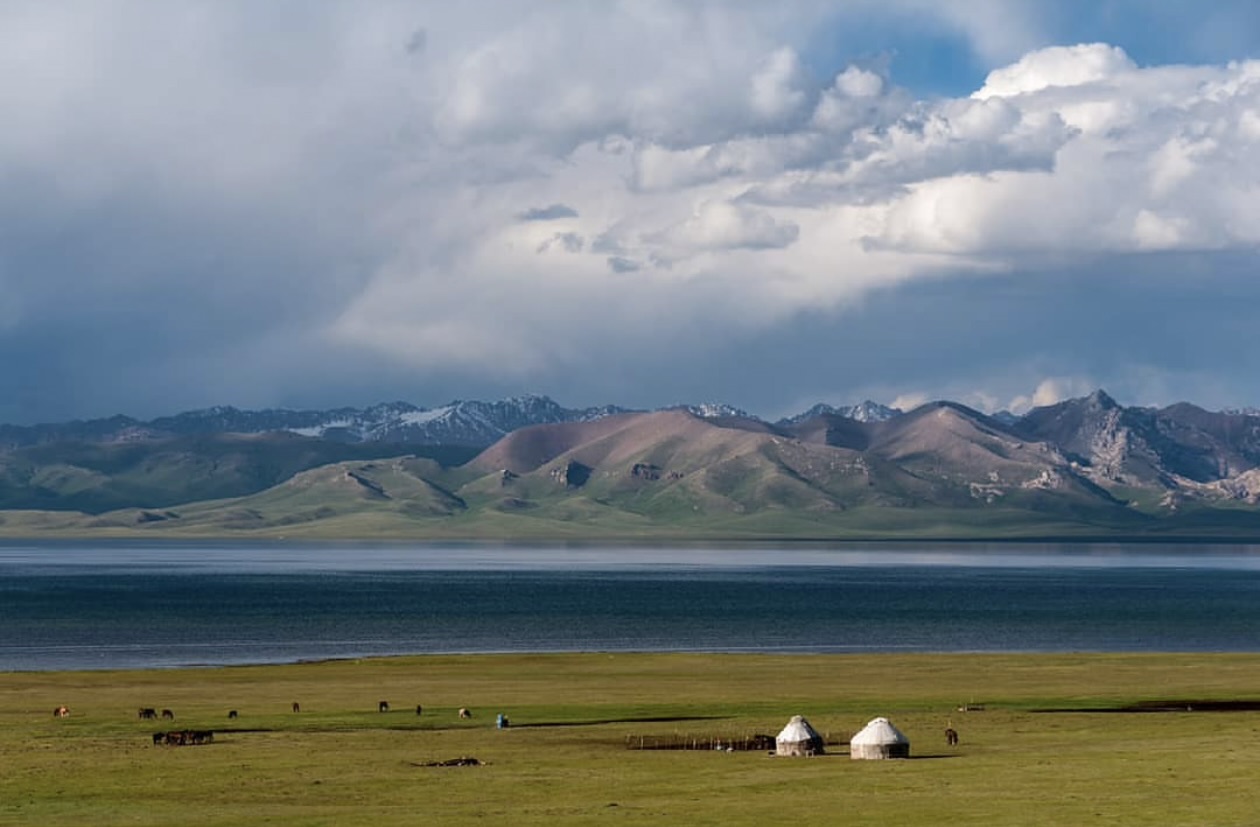
Kyrgyzstan, often called the “Switzerland of Central Asia”, draws travelers seeking dramatic landscapes, living nomadic traditions, and untamed mountain wilderness. With over 90% of its territory covered by rugged mountains, it is one of the world’s premier destinations for alpine trekking, scenic photography, and cultural immersion.
Beyond its wild geography, the country is remarkably welcoming: it maintains a liberal visa-free policy for dozens of nationalities (including travelers from the United States, Canada, and the EU) and features an established Community Based Tourism (CBT) network that makes homestays and guided expeditions straightforward to arrange.
High-Altitude Lakes & Alpine Wilds
Song-Kul is a remote alpine lake perched at over 3,000 meters above sea level, widely regarded as the quintessential setting to experience semi-nomadic pastoral life. During the brief summer months, local herders migrate up to the surrounding high-altitude pastures (jailoos) to graze livestock, filling the plains with grazing horse herds and traditional felt yurts set against mirror-like waters.
- Authentic Yurt Stays: Sleep in family-run felt yurt camps, sharing home-cooked meals of fresh bread, local honey, and kymyz (fermented mare’s milk).
- Vast Vistas & Photography: Clear high-altitude light, sweeping mountain horizons, and unpolluted night skies that provide spectacular astrophotography conditions.
- Horseback Trekking: The rolling open terrain is ideal for day rides or multi-day horseback journeys along the ridge lines.
Issyk Kul is the world’s second-largest high-altitude saline lake, ringed by the snow-capped Tian Shan mountains. Its mineral-rich waters never freeze in the winter, and its shores offer a striking contrast between sandy beaches, pine-forested gorges, and dramatic red sandstone badlands.
- Diverse Landscapes: Serves as a gateway to natural wonders like the vibrant sandstone formations of Skazka (Fairy Tale) Canyon and the red cliffs of Jeti-Oguz.
- Wildlife & Birding: A vital resting stop for migratory wetland birds, with surrounding ridges inhabited by raptors such as golden eagles and Himalayan griffons.
- Nomadic Traditions: The southern shore is the center of Berkutchi (traditional eagle hunting), where master falconers demonstrate ancestral hunting skills.
Ala Archa National Park offers immediate access to glaciated alpine terrain less than an hour’s drive south of the capital. Carved by the rushing Ala-Archa River, the gorge features sheer granite spires, roaring waterfalls, and accessible trail networks suited for day-hikers and technical climbers alike.
- Flexible Hiking Routes: Trails range from a gentle paved path along the rushing river valley to steep ascents up to the Ak-Sai Glacier and Ratsek Cabin.
- High-Alpine Wildlife: Frequent sightings of marmots, red squirrels, Siberian ibex grazing high on rocky bluffs, and bearded vultures soaring overhead.
- Spectacular Scenery: Dense juniper and spruce forests give way to dramatic scree fields and hanging glaciers within a short walking distance.
Silk Road History & Ancient Relics
Tash Rabat is a 15th-century stone fortress and caravanserai nestled deep in a high mountain valley near the Chinese border. Built to shelter merchants, monks, and camel caravans navigating the treacherous passes of the Silk Road, its stone arches and central dome evoke centuries of trans-continental trade.
- Atmospheric Architecture: Constructed entirely of local stone, featuring 31 vaulted rooms, underground chambers, and a domed central prayer hall.
- Historic Isolation: Tucked inside a remote gorge with zero urban development, offering a rare sense of quiet and ancient isolation.
- Trailhead to Chatyr-Kul: Acts as the staging point for day hikes and horse treks over the pass to the pristine waters of Lake Chatyr-Kul.
Tash-Rabat encompasses the surrounding high-altitude river valley, where seasonal nomadic herders set up small yurt camps alongside the mountain stream. Staying in the valley allows visitors to acclimate and experience the timeless rhythms of pasture life under rugged cliff faces.
- Off-Grid Stays: Cozy yurt camps heated with traditional wood stoves offer a peaceful retreat away from cell reception and city noise.
- Grazing Pastures: Wide valley floors where herds of yaks, horses, and fat-tailed sheep roam freely across the green turf.
- High-Mountain Habitats: The surrounding crags provide nesting territory for large raptors and habitat for elusive mountain ungulates.
Burana Tower is a surviving 9th-to-11th-century minaret located on the plains of the Chuy Valley, standing as the principal monument of the ancient Silk Road citadel of Balasagun. While earthquakes reduced its height over centuries, it remains an essential window into the Karakhanid empire.
- Valley Lookout: Visitors can climb the narrow, winding interior staircase to reach the top balcony for expansive views across the plains to the mountains.
- Open-Air Balbal Garden: The grounds feature an extensive field of ancient Turkic gravestones (balbals) and petroglyphs carved with detailed human faces.
- On-Site Museum: Houses preserved archaeological discoveries from the surrounding ancient city ruins, including pottery, coins, and historic metalwork.
Cultural Gateways & Base Camps
Karakol sits at the eastern tip of Lake Issyk-Kul and serves as the country’s primary mountain base camp and outdoor hub. Marked by shaded streets and historic Russian gingerbread architecture, the town reflects a cultural crossroads of Kyrgyz, Dungan, and Russian traditions.
- Historic Architecture: Highlights include the Holy Trinity Russian Orthodox Church—built entirely of wood without metal nails—and the ornate Dungan Mosque, designed in the style of a Chinese Buddhist pagoda.
- Trekking Staging Ground: The primary starting point for celebrated backcountry routes, including the multi-day trek to turquoise Lake Ala-Kul and the thermal valley of Altyn-Arashan.
- Regional Gastronomy: Famous for ashlyan-fu, a cold, sour, and spicy noodle soup brought by the Dungan community.
Bishkek is the leafy, laid-back capital of Kyrgyzstan, offering wide Soviet-era avenues, expansive public squares, and mountain views directly down the city’s north-south thoroughfares. It provides a comfortable introduction to local culture and practical logistics before heading into the mountains.
- Osh Bazaar: A market filled with spices, dried fruits, fresh mountain walnuts, flatbreads (nan), and handmade felt crafts.
- Walkable Parks: Abundant greenery, shaded boulevards, public monuments, and a burgeoning cafe and dining scene around Ala-Too Square.
- Travel Logistics: The central hub to hire 4×4 vehicles, arrange private drivers, secure border zone permits, and coordinate with local guide agencies.
Photographic Opportunities
Kyrgyzstan is one of the world’s great under-the-radar photography destinations. The sheer scale of the Central Asian landscape—where snowbound 5,000-meter Tian Shan peaks plunge into emerald alpine pastures, turquoise glacial lakes, and Martian-red sandstone badlands—offers an extraordinary variety of compositions. Paired with semi-nomadic traditions, living horse culture, and virtually zero light pollution at high elevations, the country offers exceptional opportunities across landscape, wildlife, action, astrophotography, and environmental portraiture.
Alpine Lakes & Mountain Drama
- Astrophotography & Bortle 1 Skies: Far from any city glow, night skies over the lake reveal brilliant detail along the core of the Milky Way arched above illuminated felt yurts.
- Equine Action & Herds: Herds of semi-wild horses roam freely along the water’s edge; dawn light cutting through morning mist makes for compelling telephoto action shots.
- Golden Hour Reflections: The glassy morning surface produces clean mirror reflections of distant snowcapped crests before midday winds pick up.
Song-Kul is a vast, high-altitude alpine basin at over 3,000 meters that serves as the visual centerpiece of Kyrgyz nomadic life. The mirror-flat water, ringed by gently rolling mountains and semi-nomadic yurt settlements, creates minimalist compositions defined by scale, reflection, and shifting mountain light.
Köl-Suu is a remote alpine lake near the Chinese border, hidden deep within a narrow gorge between sheer limestone cliffs that rise hundreds of meters straight out of the water. Its dramatic verticality and vivid jade-green water make it one of the most striking geological subjects in Central Asia.
- Fjord-Like Scale: Renting a small motorboat or kayak allows you to shoot straight up the canyon walls, framing the deep blue sky between sheer stone corridors.
- Telephoto Compression: Using a telephoto zoom from the shoreline or overlooking ridges isolates small boats or lone yaks against colossal, textured rock faces.
- Challenging Dynamic Range: The deep gorge creates high contrast between deep shadows and direct sun; soft mid-morning illumination or high overcast skies yield the most even exposures.
Ala-Kul Lake sits at 3,560 meters in the Terskey Alatau range, celebrated for its shifting shades of neon-turquoise and cobalt glacial melt. Framed by razor-sharp crags and hanging glaciers, it is the premier high-alpine landscape trek in the country.
- Panoramic Pass Views: Reaching the 3,914-meter Ala-Kul Pass offers an sweeping elevated perspective looking down into the glaciated cirque.
- Shifting Glacial Hues: The lake’s color transitions from brilliant aquamarine to deep slate-blue as passing cloud banks alter the reflective angle.
- Polarizer Benefits: A circular polarizing filter is invaluable here to cut surface glare and bring out the intense mineral blues beneath the surface.
Red Sandstone Badlands & Gorges
Skazka (Fairy Tale Canyon) presents a sharp contrast to the surrounding alpine greenery, featuring a maze of eroded red, gold, and ochre clay spires along the southern shore of Lake Issyk-Kul. Wind and water have carved the soft rock into hoodoos, natural arches, and miniature canyon walls.
- Graphic Textures & Patterns: Walking inside the narrow ravines provides endless opportunities for intimate landscape abstracts, focusing on banded mineral strata and natural fins.
- Low-Angle Side Light: Early morning and late afternoon light rake across the rock ridges, emphasizing texture and casting deep relief shadows across the canyon floor.
- Wide-to-Telephoto Variety: Wide-angle lenses capture the winding labyrinth corridors, while telephoto focal lengths isolate delicate pinnacles against the open sky.
Fairytale canyon marks the elevated ridge overlooking the entire canyon network, providing an expansive vantage where red desert terrain meets deep water. Standing on this crest offers the area’s most iconic establishing landscape shot.
- Crimson-and-Cobalt Contrast: Wide frames capture the warm iron-red sandstone towers in the foreground offset directly by the vivid blue expanse of Lake Issyk-Kul behind them.
- Distant Mountain Backdrops: A medium or long telephoto lens compresses the canyon spires directly against the snowcapped peaks of the Kungey Alatau range across the lake.
- Dusk Transitions: At sunset, the low sun illuminates the upper tips of the badlands in rich amber while the lake behind turns deep indigo.
Jeti Oguz is famous for its dramatic wall of sheer red sedimentary rock formations known as the “Seven Bulls,” contrasted sharply against dark green Tian Shan spruce forests. Just ahead of the main ridge lies the “Broken Heart,” an iconic split sandstone cliff.
- Natural Complementary Colors: The deep rust-red sandstone provides a striking natural color contrast against the dark green Picea schrenkiana (Tian Shan firs) and snow ridges.
- Valley of Flowers Perspectives: Venturing past the rock formations into the Kok-Jaiyk valley opens up classic mountain landscapes with winding rivers, wooden bridges, and grazing horses.
- Seasonal Changes: In early autumn (September), golden birch and willow foliage along the riverbanks adds a warm third layer to the red rock and dark evergreens.
Nomadic Culture & Lush Alpine Valleys
Bokonbayevo is the cultural hub of traditional Kyrgyz eagle hunting (Berkutchi) and falconry, situated on the southern shore of Issyk-Kul. Arranging an outing with a local master falconer provides world-class action photography and character-rich environmental portraiture.
- High-Speed Flight Action: Photographing golden eagles launching from a falconer’s gloved wrist or swooping down to a lure demands fast burst rates and high shutter speeds (1/2000s or faster).
- Authentic Portraits: Weathered masters in traditional embroidered felt kalpak hats, fox-fur garments, and leather gauntlets make compelling portrait subjects.
- Mounted Horsemanship: Handlers frequently demonstrate traditional horseback skills and archery against open steppe and foothill backdrops.
Altyn-Arashan is a picturesque, glacier-carved river valley accessed via a rugged 4×4 track, known for its wooden cabins, thermal steam, and dramatic view of the pyramidal Peak Palatka (Tent Peak).
- Morning Valley Mist: Dawn frequently brings valley mist filtering through dense spruce stands, creating striking crepuscular light rays across the riverbed.
- Glacial Peak Framing: The snow-white wall of Peak Palatka forms a clean, monumental backdrop when framed with a 70–200mm or longer lens from the cabin meadows.
- Thermal Cabin Atmosphere: Rustic wooden hot spring huts nestled along the rushing glacial stream provide cozy, atmospheric compositions during golden hour.
Practical Photography Considerations
- Focal Length Strategy:
- A wide zoom (16–35mm or 20–24mm) is essential for high-altitude pastures (jailoos), interior yurt shots, slot canyon corridors, and astro-landscapes.
- A standard zoom (24–70mm or 24–105mm) handles day-to-day street scenes, cultural portraits, and environmental framing.
- A telephoto zoom (100–400mm) is exceptionally valuable in Central Asia to compress massive peaks behind pastoral foregrounds and to capture wildlife, raptors, and distant ridgeline horseback riders.
- Dust & Silt Protection: High-mountain steppe trails and badland canyons kick up fine dust, especially during dry summer and autumn months. Lens-changing should be done carefully inside a tent or vehicle, and keeping a blower and microfiber cloths readily accessible is essential.
- Cold & Battery Management: Even in midsummer, night temperatures at elevations above 3,000 meters routinely drop near freezing. Keep spare batteries stored in an interior pocket close to body heat so astrophotography and early-morning sunrise sessions are not cut short.
Sample 10-12 Day Photo Excursion
The Central Kyrgyzstan Loop is the quintessential 10-to-12 day 4×4 photography route. It connects alpine lake basins, red-rock badlands, high mountain passes, Silk Road relics, and traditional semi-nomadic pasture life.
Navigating this loop requires a high-clearance 4×4 vehicle (such as a Toyota Land Cruiser or 4Runner) to tackle unpaved gravel switchbacks, riverbed crossings, and high-elevation dirt tracks over 3,000-meter passes.
Days 1–2: Silk Road Steppe & Mountain Gateways
Bishkek serves as the staging ground where you will pick up your 4×4, secure local SIM cards, test satellite communicators, and purchase supplies before venturing into off-grid territory. The city’s tree-lined Soviet avenues and bustling open-air bazaars offer an immediate contrast to the rugged wilderness ahead.
- Street & Market Photography: The expansive Osh Bazaar provides rich candid portraiture and close-up documentary opportunities featuring spice pyramids, hand-stamped flatbreads, and felt craft stalls.
- Logistics & Preparation: Use this initial window to verify emergency recovery gear (tow straps, compressor, full-size spare) and ensure camera batteries are fully charged.
Burana Tower is a surviving 11th-century minaret standing on the plains of the Chuy Valley, located an hour east of the capital. The surrounding archaeological field is dotted with ancient stone anthropomorphic grave markers (balbals) carved with distinct human faces and weapons.
- Low-Angle Composition: Position wide-angle lenses close to the weathered balbals in the foreground, framing the historic minaret and distant snow peaks behind them.
- Side-Lighting: Mid-morning side-light accentuates the intricate relief carvings on the ancient stone figures and the patterned brickwork of the tower.
Chon-Kemin is a lush, protected alpine river valley tucked between the Kungey-Alatau and Zailiyskiy ranges. Its gentle meadows, traditional wooden guesthouses, and pine-clad hills provide an ideal first overnight stop to acclimate to higher terrain.
- Pastoral Landscapes: Classic rural scenes of grazing horse herds against dense spruce-covered hillsides and winding streams.
- Dusk Lighting: The deep east-west valley catches rich warm illumination late in the day, ideal for medium-telephoto shots of horses returning from pasture.
Issyk Kul opens up on Day 2 as you drive along its northern shoreline toward the eastern end of the country. Ringed by 4,000-meter glaciated ridges, the world’s second-largest high-altitude saline lake provides vast horizons where open water directly meets glaciated peaks.
- Telephoto Mountain Compression: A 100–400mm lens allows you to compress distant, snowcapped southern peaks directly against the vast expanse of blue water.
- Shoreline Reflection: Calm early-morning conditions produce glassy reflections of surrounding mountain ranges before afternoon thermal winds pick up.
Days 2–4: Terskey Alatau Gorges & Southern Badlands
Karakol sits at the eastern foot of the lake, serving as the cultural crossroads and trekking capital of Kyrgyzstan. Its shaded lanes are famous for distinctive 19th-century Russian gingerbread cottage architecture and multicultural culinary traditions.
- Architectural Heritage: Photograph the Holy Trinity Russian Orthodox Cathedral—built entirely of wood without nails—and the ornate, pagoda-style Dungan Mosque.
- Sunday Animal Market: If timing aligns with a Sunday morning, the sprawling livestock market provides raw, fast-moving documentary photography of local herders trading horses and sheep.
Jeti Oguz is famous for its dramatic red sedimentary cliff formations, most notably the “Seven Bulls” and the “Broken Heart.” The vivid rust-red sandstone provides a striking natural contrast against dark green spruce forests and snow-dusted crags.
- Complementary Color Framing: The intense crimson cliffs stand out brilliantly against deep green fir trees and brilliant morning blue skies.
- Kok-Jaiyk Pastures: Continuing the 4×4 track further up the valley opens into wide meadows featuring traditional wooden footbridges and mountain streams.
Barskoon is a quiet settlement along the southern lake shore that guards the entrance to one of the country’s most dramatic glaciated mountain gorges. The road leading south from the village climbs aggressively into high alpine tundra via steep dirt switchbacks.
- Transit Hub: The staging ground for ascending into the high Terskey Alatau mountain passes leading to glacial plateaus.
- Rural Steppe Scenes: Winding dirt lanes lined with poplars and traditional mudbrick homesteads framed by towering mountain backdrops.
Barskoon Waterfall cascades down a sheer granite cliff surrounded by dense Tian Shan spruce forest inside the gorge. A short, moderately steep footpath leads from the rough gravel roadway to viewpoints overlooking the falling glacial melt.
- Long-Exposure Water: Use neutral density (ND) filters to smooth out the rushing glacial water against dark granite rock faces and emerald mosses.
- Elevated Valley Perspectives: Looking down the gorge from the falls reveals steep forested ridges converging toward the lake plain.
Fairytale canyon is a surreal maze of eroded red, gold, and ochre sandstone towers and narrow clay ravines perched above the southern shore of the lake. The badland formations are best photographed at sunrise when low-angled light emphasizes natural strata and texture.
- Graphic Textures & Abstract Compositions: Early morning light casts deep shadows across wind-carved sandstone spires, hoodoos, and narrow clay corridors.
- Warm-and-Cool Contrast: Frame the warm crimson rock in the foreground offset directly against the cold, deep blue waters of the lake in the background.
Bokonbayevo is the traditional center of Kyrgyz falconry and eagle hunting (Berkutchi). Arranging an afternoon session with a local master hunter provides incredible opportunities for action photography and character-driven environmental portraits.
- Flight Action: Fast burst shooting (1/2000s or faster) captures golden eagles launching from leather gauntlets or swooping onto target lures against open steppe.
- Character Portraits: Master hunters dressed in traditional embroidered felt kalpak hats and heavy fox-fur coats make compelling portrait subjects in golden hour light.
Days 5–6: Silk Road Caravans & High Passes
Kochkor is a mountain crossroads town renowned for preserving traditional Kyrgyz wool felt handicraft traditions, particularly decorative shyrdak carpets.
- Artisan Documentary: Local women’s cooperatives welcome photographers to document the multi-step process of cleaning wool, dyeing patterns, and hand-stitching intricate mosaic felts.
- Crossroad Character: A bustling regional hub with vibrant local hardware and produce markets along the main thoroughfare.
Naryn is a high-altitude provincial capital set along a rushing river gorge surrounded by stark clay cliffs. It serves as the primary supply hub and refueling station before venturing south toward the Chinese frontier or ascending to alpine lakes.
- River Gorge Vistas: The turquoise, silty river cutting through arid red cliffs offers dramatic landscape perspectives from overlooking bluffs.
- Remote Urban Life: Wide, dusty streets framed by stark, tree-free mountain ridges convey the isolated frontier atmosphere of Central Asia.
Tash Rabat is a 15th-century stone caravanserai hidden deep inside an isolated mountain valley at 3,200 meters, historically sheltering Silk Road merchants crossing the Tian Shan. The solitary stone fortress features 31 domed chambers set against steep, barren crags.
- Historic Atmosphere: Low-angled light entering the central stone dome illuminates vaulted corridors and ancient masonry chambers.
- Valley Yurt Stays: Staying in rustic yurt camps nearby allows you to shoot grazing yak herds under high cliff faces and dark, unpolluted night skies.
Days 7–9: The Alpine Crown & Deep Gorges
Song-Kul is the crown jewel of the loop, an alpine lake resting at over 3,000 meters accessible via the dramatic 33 Parrots switchback pass. Semi-nomadic herders spend the summer months here grazing horse herds across vast meadows dotted with white felt yurts.
- Pristine Astrophotography: Zero light pollution and high elevation create Bortle Class 1 night skies, allowing you to capture the core of the Milky Way arched over glowing yurt camps.
- Equine Action & Sunrise: Glassy dawn waters reflect morning mist and free-roaming horse herds galloping along the water’s edge.
- Nomadic Way of Life: Document family life inside felt yurts, milking mares for kymyz, and preparing bread over traditional wood stoves.
Kyzyl-Oi is reached via the rugged Kara-Keche dirt pass, descending into an isolated valley flanked by colossal red-clay mountains along the rushing Kokomeren River. The village’s traditional clay-brick houses blend seamlessly into the surrounding ochre canyon.
- Canyon Contrasts: The turquoise-tinged waters of the Kokomeren River run directly beneath towering red clay formations, especially vibrant in early-morning side light.
- Authentic Village Life: Quiet dirt lanes, roaming livestock, and clay homesteads surrounded by apple orchards provide intimate environmental documentary scenes.
Days 10–12: High Steppe Return & Bishkek Buffer
- Day 10 (Kyzyl-Oi to Bishkek): Drive through the sweeping high-altitude pastures of the western mountain steppe, crossing the high-elevation tunnel pass before descending the winding switchbacks back to the capital.
- Day 11 (Buffer & Alpine Excursion): Keep this day flexible in case bad weather or flat tires cause minor delays in the mountains. If on schedule, take an easy 45-minute drive south of the capital into glaciated alpine valleys for day hiking and marmot or raptor photography.
- Day 12 (Departure): Final gear packing, souvenir shopping at local felt workshops, and departure flights from the international airport.
4×4 & Travel Photography Tips
- Tire Pressure & Spares: Off-road mountain routes like the Kara-Keche pass feature sharp shale and deep ruts. Carry a 12V air compressor to adjust tire pressures between paved highways and rocky passes, and carry a full-size spare tire.
- Dust Protection: Dirt tracks kick up fine silt. Keep cameras inside sealed dry bags while driving, and avoid changing lenses outdoors when mountain winds are blowing.
- Cold Power Management: Night temperatures at 3,000+ meters (especially at Song-Kul and Tash Rabat) frequently drop near freezing even in midsummer. Keep camera batteries inside your sleeping bag or jacket pocket to prevent sudden power drainage during astro sessions.
Created with the help of an AI LLM

