
A pivotal figure in early 18th-century moral philosophy, aesthetics, and political thought.
Though less well-known today than contemporaries like Locke or Hobbes, Shaftesbury’s ideas had a profound impact on British Enlightenment thought, particularly in shaping moral sentimentalism and the emerging discourse on aesthetic judgment and virtue ethics.
Key Works
His major work is Characteristics of Men, Manners, Opinions, Times (1711), a collection of treatises, dialogues, and essays, which includes:
“A Letter Concerning Enthusiasm” “Sensus Communis: An Essay on the Freedom of Wit and Humor” “The Moralists: A Philosophical Rhapsody” “Soliloquy, or Advice to an Author”
Core Philosophical Ideas
1. Moral Sense Theory
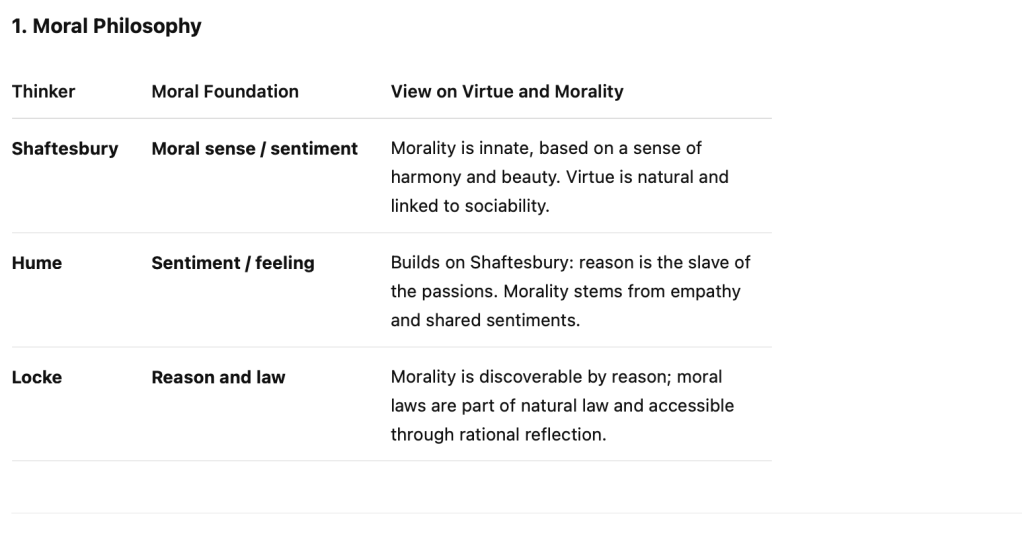
Shaftesbury was one of the earliest advocates of the idea that morality is rooted in sentiment, not reason alone.
He argued that humans have a natural moral sense or instinct that allows them to recognize virtue and vice. This view laid the groundwork for Hutcheson and later David Hume, who expanded on moral sentimentalism.
2. Harmony and the Aesthetic of Virtue
He believed the universe is fundamentally ordered and harmonious, and that virtue consists in acting in accordance with that natural harmony.
Morality and aesthetics are closely tied: the good is also the beautiful, and virtue is a kind of natural grace. This notion of harmony influenced both aesthetic theory and the idea of a moral order discoverable through sentiment and reason combined.
3. Innate Sociability
Shaftesbury rejected Hobbesian egoism. He believed humans are naturally social, benevolent creatures, and that self-interest must be balanced by concern for others.
His ethics thus stress balance between self-love and love of others, advocating for moderation, civility, and public spiritedness.
4. Critique of Religious Enthusiasm
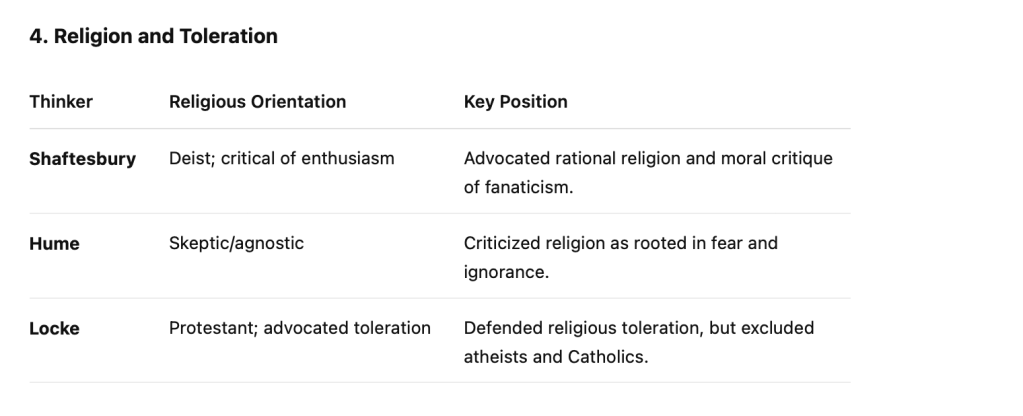
In works like “A Letter Concerning Enthusiasm”, he criticizes religious fanaticism and superstition, calling instead for rational religion, tolerant debate, and humor as a check on dogmatism.
He was a Deist who promoted reasoned belief in a providential order rather than scriptural literalism.
5. Wit, Ridicule, and Free Speech
Shaftesbury defended wit and satire as tools of enlightenment and moral correction.
He believed ridicule could expose absurdity and promote reason—an early argument for free expression in civil society.
Influence
David Hume acknowledged Shaftesbury’s moral sense theory as a major influence. His ideas shaped Scottish Enlightenment figures like Hutcheson and Reid. Shaftesbury also prefigured later aesthetic theories, contributing to the idea of the sublime and beautiful as moral categories. His emphasis on virtue and character also echoes in modern virtue ethics.
Style and Legacy
His writing style is erudite, dialogic, and literary, often laced with classical references and irony. Though Shaftesbury avoided system-building, his influence was wide, blending Stoicism, Platonism, and modern liberal humanism.
He offered a vision of moral life grounded in feeling, beauty, and sociability, rejecting both religious zealotry and mechanistic accounts of human nature.
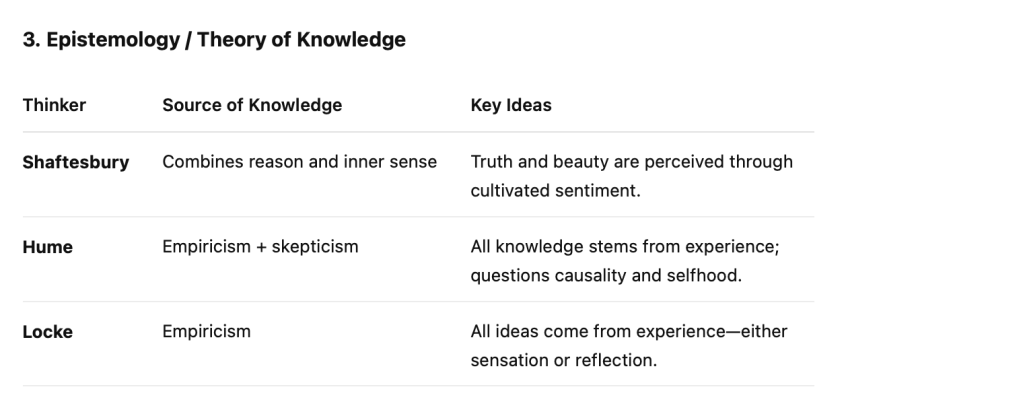
Comparison of Shaftesbury, Hume, and Locke

 Dr Bob, Brain Mechanic