
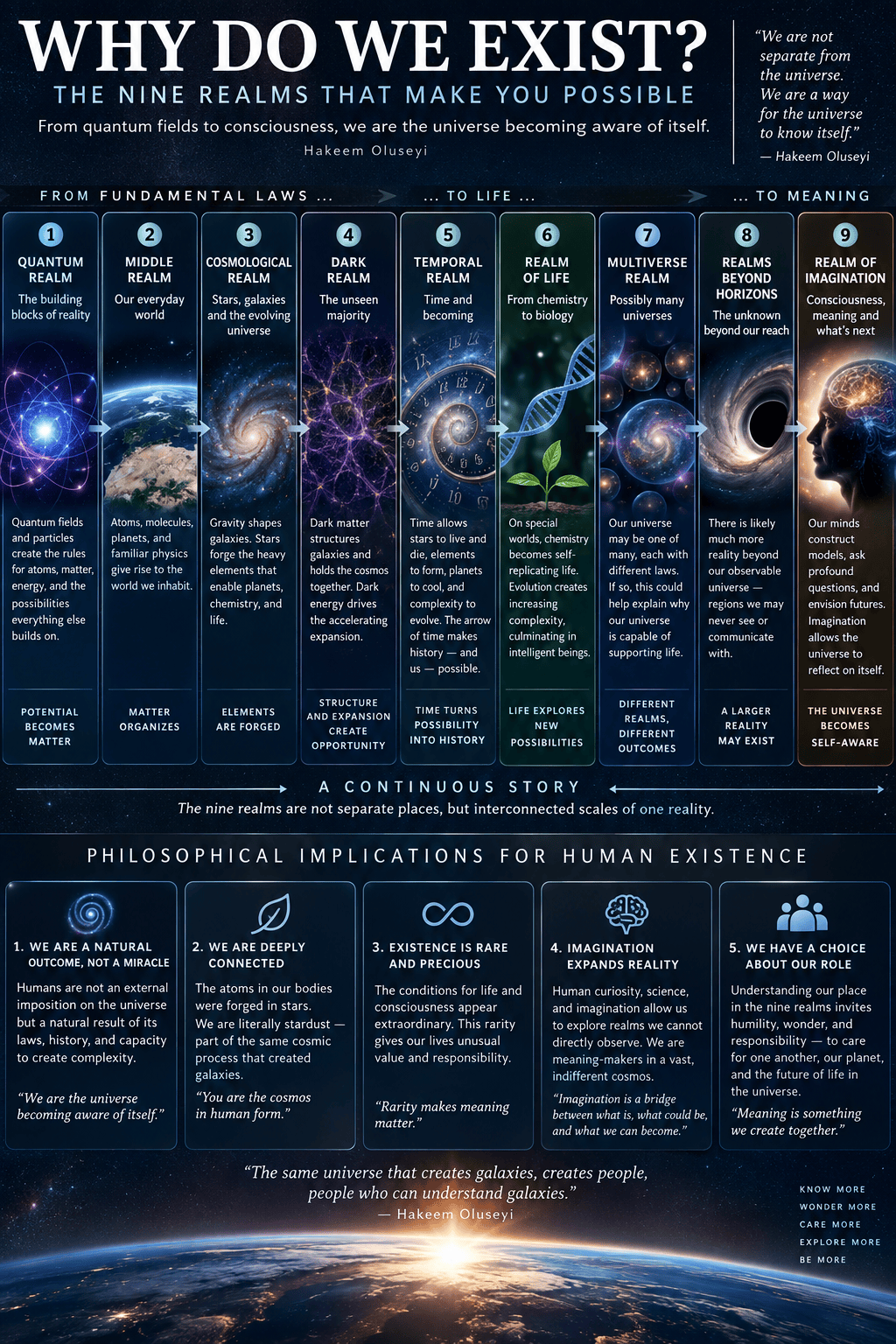
The Nine Realms of Universe that Make You Possible Book by astrophysicist Hakeem Oluseyi with Nils Johnson-Shelton, published in April 2026. Oluseyi’s central idea is that human existence becomes comprehensible when reality is viewed at several radically different scales. The laws governing quarks, people, stars, galaxies, and the universe appear very different, yet they areContinueContinue reading “Why Do We Exist?”
Tag Archives: Philosophy
Critique: Psychedelics align brain activity
Nature 656:936–947, 2026 “Psychedelics can profoundly alter consciousness by reorganizing brain connectivity, producing acute experiences that shape lasting psychological change, Psychedelic dynamics are commonly described as desynchronized or entropically disordered, yet the brain organization underlying self-dissolving and boundary-dissolving experiences that participants often report, and how context shapes that organization, remain unresolved. To address this, weContinueContinue reading “Critique: Psychedelics align brain activity”
I think 99 times and find nothing.
“I think 99 times and find nothing. I stop thinking, swim in the silence, and the truth comes to me” The quote is frequently attributed to Albert Einstein on social media and internet quote sites, where it is shared as a poetic take on his famous problem-solving approach. However, there is no historical record ofContinueContinue reading “I think 99 times and find nothing.”
Thomas Schelling, John Boyd and Stanley Kubrick Smoke a Cigar
Nota Bene: This is a ChatGTP analysis and critique of a Substack Post 1. Schelling absolutely matters The author correctly identifies Thomas Schelling as one of the foundational thinkers of nuclear strategy, coercion, signaling, deterrence, and bargaining. Key concepts accurately described: – Deterrence vs compellence – Escalation management – Signaling and credibility – “The threatContinueContinue reading “Thomas Schelling, John Boyd and Stanley Kubrick Smoke a Cigar”
Remember Amalek
Biblical Scapegoating? In the aftermath of the October 7 attacks, Benjamin Netanyahu invoked a powerful biblical phrase: “Remember what Amalek has done to you.” He later clarified that he was referring to Hamas, not Palestinians as a whole. But the word itself carries a gravity that cannot be easily contained. “Amalek” is not simply anContinueContinue reading “Remember Amalek”
“The Elephant and the Angels”: An Analysis
This essay by John Murray Cuddihy, published in Uncivil Religion: Interreligious Hostility in America (eds. Robert N. Bellah & Frederick E. Greenspahn, Crossroad, 1987), is a provocative sociological and theological critique of what Cuddihy calls “Jewish theodicy”, the way Jewish discourse handles the problem of evil, specifically anti-Semitism, and argues that this discourse carries anContinueContinue reading ““The Elephant and the Angels”: An Analysis”
What Happens When We Die?
What happens to us when we really die? Lots of different opinions on this one. Which one do you subscribe to? Paulo Coelho: Death is ever-present and learning to live with its inevitability transforms how we live now. He shares personal practice (imagining being buried alive) to show that confronting death directly fosters appreciation ofContinueContinue reading “What Happens When We Die?”
Goliath’s Curse
Luke Kemp’s Goliath’s Curse is a brilliant, unnerving, and strangely hopeful journey through the rise and fall of civilizations. Like Sapiens meets Mad Max, it exposes a central truth: the bigger and more unequal societies become, the more fragile they are. Drawing on thousands of years of history and cutting-edge data, Kemp argues that the real cause of collapse isn’tContinueContinue reading “Goliath’s Curse”
Peter Thiel’s Apocalypse
Audio Version (please click for RSS) Overcast Link Faith, Fear, and the Future of Technology Yet another billionaire’s attempt to warp, manipulate and re-interpret the Bible for his own world view? Peter Thiel, the billionaire investor behind some of Silicon Valley’s most powerful technology firms (and JD Vance!), is urging audiences to see the futureContinueContinue reading “Peter Thiel’s Apocalypse”
The Risks of “Seemingly Conscious AI
Click for Audio Version (AI Generated 😬) This is an area that I’ve been thinking about for some time. What if an an AI model took control of a corporation, which in the US has certain rights mirroring personhood (see Citizen’s United Supreme Court decision?) Would the AI model then be able to legally actContinueContinue reading “The Risks of “Seemingly Conscious AI”
 Dr Bob, Brain Mechanic