
“I think 99 times and find nothing. I stop thinking, swim in the silence, and the truth comes to me”
The quote is frequently attributed to Albert Einstein on social media and internet quote sites, where it is shared as a poetic take on his famous problem-solving approach. However, there is no historical record of Einstein ever saying this exact phrase.
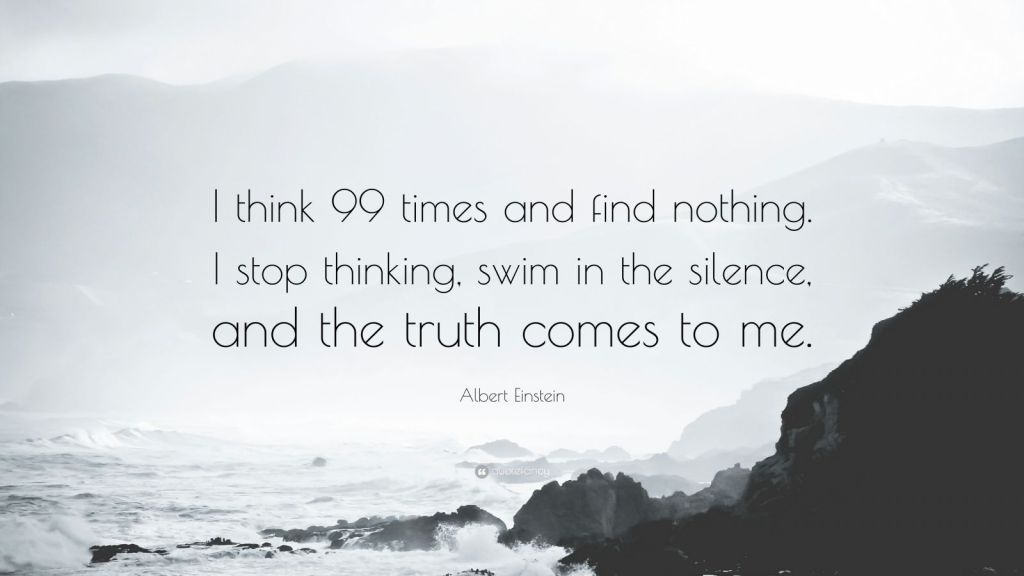
It is likely a modernized, paraphrased internet adaptation of a genuine quote attributed to him regarding his problem-solving process: “I think and think for months and years. Ninety-nine times, the conclusion is false. The hundredth time I am right.”
This original version was famously cited by Einstein in a 1944 New York Times article, highlighting how persistence and trial-and-error ultimately give way to the right answer. Over time, this evolved on social media into the more stylized and meditative quote you shared.
Meaning and Context
Both the original and the popularized version speak to the same core principles of his creative and scientific process:
- The Power of Incubation: Einstein was a major proponent of stepping away from a problem. He famously used “thought experiments” (Gedankenexperiments) and would play the violin when he hit a mental wall, allowing his subconscious mind to organize information.
- Resilience in Failure: He openly acknowledged that the vast majority of his initial hypotheses and intellectual pursuits resulted in dead ends before he ever found a breakthrough.
- Value of Silence: The modern variation emphasizes the importance of silencing analytical chatter to allow “aha!” moments to surface, a phenomenon deeply studied in the psychology of creative insight.
Albert Einstein called his thought experiments Gedankenexperiments. These mental scenarios allowed him to visualize complex physics problems without a laboratory, directly leading to his theories of Special Relativity, General Relativity, and Quantum Mechanics.
Here are his four most famous thought experiments, ordered by how they shaped his breakthroughs.
- Chasing a Beam of Light (Age 16)
The Breakthrough: Special Relativity (1895–1905)
The Scenario: Einstein imagined what it would look like to run alongside a wave of light at the exact same speed.
The Physics: According to classical physics, the light wave should appear frozen next to him, like a stationary wave.
However, Maxwell’s equations governing electromagnetism state that light always moves at a constant speed ($c \approx 3 \times 10^8 \text{ m/s}$) and cannot stand still.
The Realization: Einstein concluded that classical mechanics was flawed. Light can never appear frozen. Instead, time and space must stretch or compress depending on the observer’s motion to keep the speed of light perfectly constant.
- The Train and the Lightning Bolt
The Breakthrough: Relativity of Simultaneity (1905)
The Scenario: Imagine a long train moving at a constant speed. A person stands perfectly still on the ground next to the tracks. A second person sits exactly in the middle of the moving train.
Two bolts of lightning strike the front and the back of the train at the exact same moment.
The Physics: The ground observer sees both lightning bolts hit simultaneously because the light from both strikes travels the exact same distance to their eyes.
The train observer is moving toward the front strike and away from the rear strike.
They see the front flash first because that light has a shorter distance to travel to reach their moving eyes.
The Realization: Time is not absolute. Two events that are simultaneous for one observer are not simultaneous for another moving observer.
- The Falling Elevator
The Breakthrough: General Relativity (1907)
The Scenario: Einstein called this “the happiest thought of my life.” He imagined a man inside a windowless elevator box.
Scenario A: The elevator cable snaps, and the box falls freely down a shaft. The man floats inside, feeling weightless.
Scenario B: The elevator is out in deep space, completely away from any planet’s gravity, but a rocket accelerates the box upward at $9.8 \text{ m/s}^2$. The man’s feet are glued to the floor, feeling a normal pull downward.
The Physics: In Scenario A, the man cannot tell if he is falling through a gravitational field or floating in empty space.
In Scenario B, the man cannot tell if he is standing still on Earth or accelerating through deep space.
The Realization: Gravity and acceleration are completely indistinguishable. This became the Equivalence Principle, which led Einstein to realize that gravity is not a pulling force, but rather the bending of space and time caused by mass.
- The Exploding Clock Box (The EPR Paradox)
The Breakthrough: Challenging Quantum Mechanics (1930–1935)
The Scenario: Einstein disliked the randomness of quantum mechanics. He proposed a box filled with light.
A precise clock opens a shutter for a split second, letting exactly one photon (particle of light) escape.
By weighing the box before and after, you can determine the exact mass lost ($\Delta m$).
Using $E = \Delta m c^2$, you can calculate the exact energy of the photon.
The Physics: According to Heisenberg’s Uncertainty Principle, you cannot simultaneously measure the exact energy of a particle and the exact time it was emitted.
Yet, Einstein’s box measured the exact time (via the clock) and the exact energy (via weighing the box).
The Outcome: While Niels Bohr later defended quantum theory by proving Einstein forgot to account for gravitational time dilation on the clock inside the box, this thought experiment pushed the boundaries of quantum entanglement.
This post was instigated after reading a newsletter by Kat (Katrijn) Van Oudheusden

