
Thomas Hobbes and John Locke both wrote during times of political turmoil in England, but they arrived at starkly different conclusions about human nature, the role of government, and the social contract.
1. Human Nature
Hobbes: Believed humans are naturally selfish, brutish, and driven by fear and desire for self-preservation. In the state of nature, life would be “solitary, poor, nasty, brutish, and short.” Locke: Had a more optimistic view. Believed people are rational, moral, and capable of self-restraint. In the state of nature, individuals have natural rights—life, liberty, and property.
2. State of Nature
Hobbes: The state of nature is a state of war—chaotic and violent. Without a strong authority, there can be no order or security. Locke: The state of nature is not necessarily violent, but inconvenient due to lack of impartial justice. People generally respect natural law, but disputes can arise.
3. Social Contract
Hobbes: People give up all rights to an absolute sovereign (the Leviathan) in exchange for security and order. Once agreed upon, the sovereign’s authority is nearly unquestionable. Locke: People agree to form a government to protect their natural rights. If the government fails to do so, they have the right to alter or abolish it.
4. Government
Hobbes: Advocated for a powerful, centralized, absolute monarchy. Liberty is secondary to order. Locke: Favored constitutional government with checks and balances. Liberty is essential, and government exists by the consent of the governed.
5. Right to Revolt
Hobbes: No right to revolt—rebellion leads back to chaos. Locke: Citizens have not just a right but a duty to revolt against tyrannical rule.

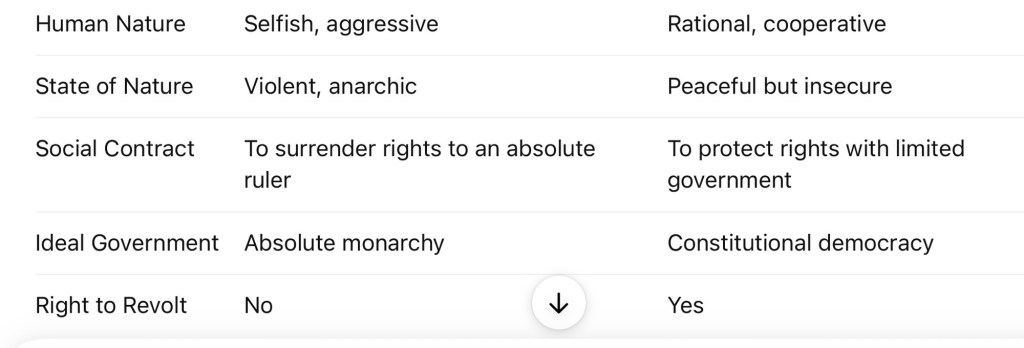
Locke’s ideas deeply influenced liberal democracy and the American Revolution, while Hobbes laid the groundwork for authoritarian political theory.
 Dr Bob, Brain Mechanic