
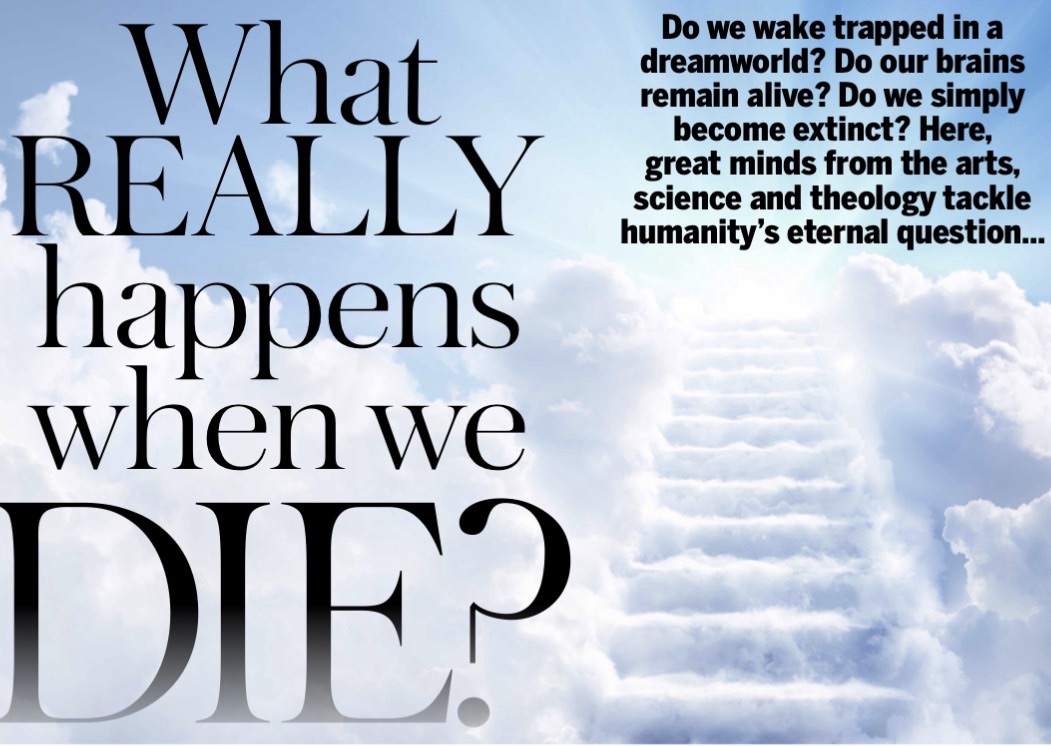

Lots of different opinions on this one. Which one do you subscribe to?
Paulo Coelho: Death is ever-present and learning to live with its inevitability transforms how we live now. He shares personal practice (imagining being buried alive) to show that confronting death directly fosters appreciation of life’s present moment and priorities.
Uri Geller: Argues that since matter and energy can’t be destroyed (citing Einstein’s E=mc²), there must be some non-physical aspect (soul, spirit, aura) that continues after death. He believes we enter another dimension and reunite with loved ones, with afterlife determined by how we live.
Carlo Rovelli: Science-grounded materialist take: an afterlife doesn’t exist beyond others’ memories of us. He sees life’s finitude as giving it value and urges focusing on life here and now rather than mythical beyonds.
Elif Shafak: Uses recent neuroscience observations to question the simplicity of death as a sudden end; points out the brain can remain active briefly after the heart stops. She reframes death as a complex transition where consciousness may persist momentarily, and emphasizes we don’t yet know whether there’s a soul.
Lord Sumption: Clear existential realist: death is extinction. Nothing persists beyond physical demise, and that finality is personally comforting to him.
Rupert Sheldrake: Speculative perspective: after death we continue “dreaming” in a nonphysical dreamworld because we lack a physical body to wake in. This realm is shaped by memories, fears, hopes, relationships, and faith; we may evolve further or pass to a mystical union with “ultimate reality.” He also suggests prayers from the living may help the deceased.
Rabbi Dr Jonathan Romain: Judaism is vague on specifics; he uses the metaphor of a raindrop merging into a puddle to suggest individuality dissolves back into a larger source. He emphasizes we can’t know for sure and should focus on living well in this world.
Libby Purves: Cultural-thematic blend: she invokes Christian imagery but ultimately embraces uncertainty. She references C.S. Lewis’s idea that an afterlife’s nature depends on how we lived, but stops short of dogma, preferring mystery and metaphor over hard claims.
Point-by-point comparison
Ontological basis (What exists after death?)
• Physicalist/no afterlife: Carlo Rovelli, Lord Sumption — no continuation beyond death; any “afterlife” is memory or nonexistence.
• Metaphorical/unknown: Elif Shafak, Rabbi Romain, Libby Purves — death is complex, perhaps beautiful or mysterious, but not conclusively a soul’s continuation.
• Non-physical continuation: Uri Geller, Rupert Sheldrake — propose some kind of continued existence, whether dimension-based reunion with loved ones (Geller) or dreamlike conscious realm (Sheldrake).
Role of science
• Science confirms material end: Rovelli uses modern physics as explanatory basis for no afterlife.
• Science opens questions but not answers: Shafak points to brain activity post-mortem as intriguing but not proof of survival.
• Science as analogy: Geller uses scientific law (energy conservation) rhetorically; Sheldrake mixes speculative biology with metaphysics.
Spiritual/religious framing
• Explicit faith in afterlife: Geller, Sheldrake (to varying degrees, Sheldrake ties to mystical traditions).
• Agnostic/uncertain faith: Romain, Purves: incorporate religion more as metaphor or tradition than definitive truth.
• Secular finality: Rovelli, Sumption reject spiritual frameworks.
Attitude toward death’s meaning
• Affirms life’s value through finitude: Rovelli, Sumption, Coelho: death gives urgency, clarity, or focus to life.
• Transforms meaning through continuity: Geller, Sheldrake: continuity changes how life’s end is conceived.
• Mystery embraced without firm stance: Shafak, Romain, Purves: uncertainty is part of the human experience.
Underlying assumptions
• Some viewpoints treat consciousness as reducible (material brain processes), others treat it as non-material or dimension-spanning.
• Religious or spiritual interpretations assume some metaphysical reality beyond science; secular views assume science is the boundary of meaningful explanation.
Takeaway
The article is less about converging on an answer and more about how diverse intellectual traditions grapple with mortality, from material extinction to mystical continuation, from metaphorical meaning to experiential neuroscience.
• Material views ground meaning in the finite here and now.
• Speculative spiritual views extend personal continuity in non-empirical domains.
• Uncertain/poetic views hold space for mystery and lived experience without assertion.
 Dr Bob, Brain Mechanic