
A meta-analysis of 192 studies found that untrained individuals doing moderate-load resistance training just twice per week capture ~77% of strength gains, near-maximal muscle growth, and the full mobility benefits of more demanding protocols.
The authors use this to define a “minimum effective protocol”: 2 sessions/week, moderate weight (8–12 rep range), 3–4 sets per exercise, compound movements, no need to train to failure.
The core argument is behavioral: the main barrier to resistance training isn’t lack of an optimal program, it’s starting and sticking with one. A lower-barrier protocol that delivers most of the benefit beats a theoretically superior program nobody follows.
Strengths
• Large evidence base (192 studies) with a sensible focus on untrained populations, where the health ROI of resistance training is highest
• Practically useful framing — asking “what’s sufficient?” rather than “what’s optimal?” is the right question for most people
• The mobility finding is particularly clean and clinically meaningful for older adults
Weaknesses
• “Intensity” was operationalized as % of 1RM, ignoring proximity to failure, a significant omission given how central that variable is to modern training science
• Lumping together “untrained” participants (zero experience through lapsed trainees) introduces heterogeneity that could blur effect sizes
• The 77% strength figure is presented somewhat optimistically, that’s a statistically significant gap, not a rounding error, especially for anyone with performance goals
• The leap from physiology to behavior (“lower barrier = better adherence”) is asserted rather than demonstrated, no adherence data is actually in the meta-analysis
Overall it’s a well-reasoned piece, but the behavioral conclusion is the weakest link: a simpler program isn’t automatically one people stick to.
Here’s the expanded minimum effective protocol with exercise recommendations built around the study’s framework:
The Minimum Effective Protocol Exercise Guide
Structure:
2 sessions/week | 3–4 sets per exercise | 8–12 reps | Moderate weight | Rest 60–90 sec between sets
Why Compound Movements
The study emphasizes compound movements for good reason, they train multiple muscle groups simultaneously, giving you more physiological return per exercise.
A squat trains quads, hamstrings, glutes, and core. A row hits back, biceps, and rear shoulders. This is how you get full-body stimulus in a short session.
Session A
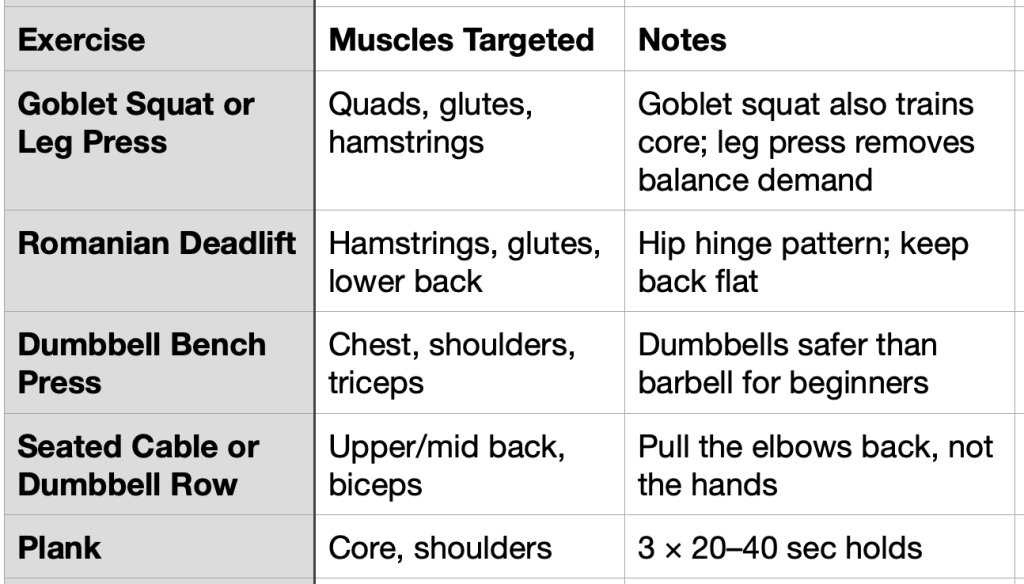
Session B
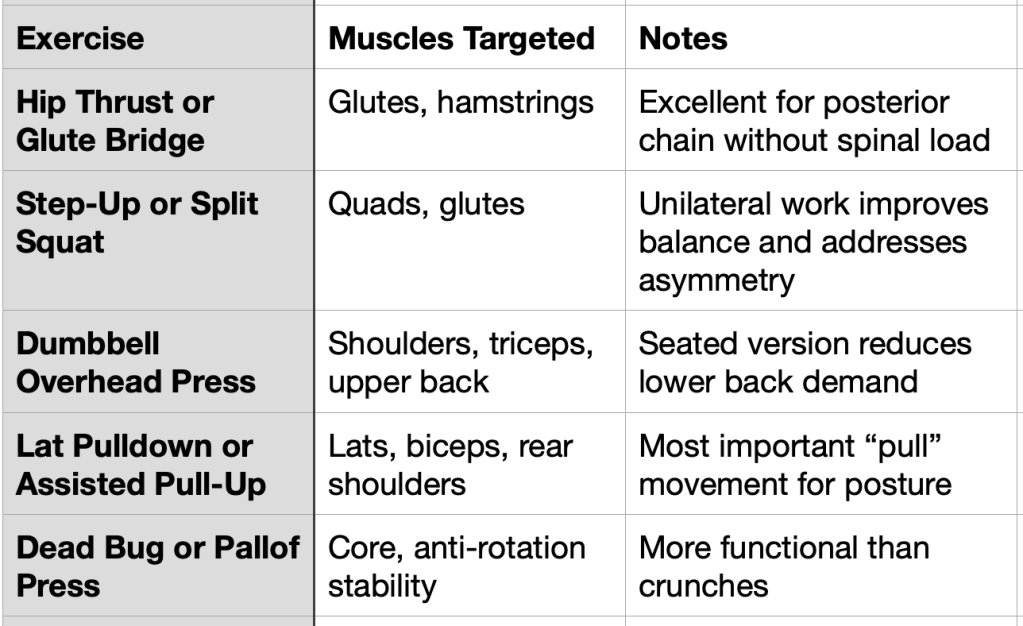
Programming Notes
On load selection: Pick a weight where the last 2–3 reps of each set feel genuinely challenging but form doesn’t break down. You shouldn’t be grinding — but you shouldn’t be coasting either. This roughly corresponds to leaving 2–3 reps in reserve, which the meta-analysis implicitly captured without formally measuring it.
On progression: Add a small amount of weight (2.5–5 lbs) when you can complete all sets at the top of the rep range (12 reps) with good form. This is called progressive overload and is the single most important long-term driver of strength and muscle gain.
On the mobility findings: Notice that Session B leans into unilateral and hip-dominant movements. These are disproportionately responsible for the mobility benefits seen in the study, particularly the Timed Up and Go and sit-to-stand improvements. Step-ups, split squats, and hip thrusts directly train the movement patterns that underlie functional independence.
What to Drop as You Progress
The meta-analysis is explicit that this protocol is a starting point, not a ceiling. Once this feels manageable, typically 8–12 weeks in, logical next steps include:
• Adding a third weekly session
• Introducing heavier compound lifts (barbell squat, conventional deadlift, barbell row)
• Gradually increasing proximity to failure on key sets
• Periodizing load across training blocks
At that point you’re no longer an untrained individual, and the study’s findings no longer define your ceiling — they defined your entry point.
Modified from Resistance Training: Lowering the Barrier to Entry

