
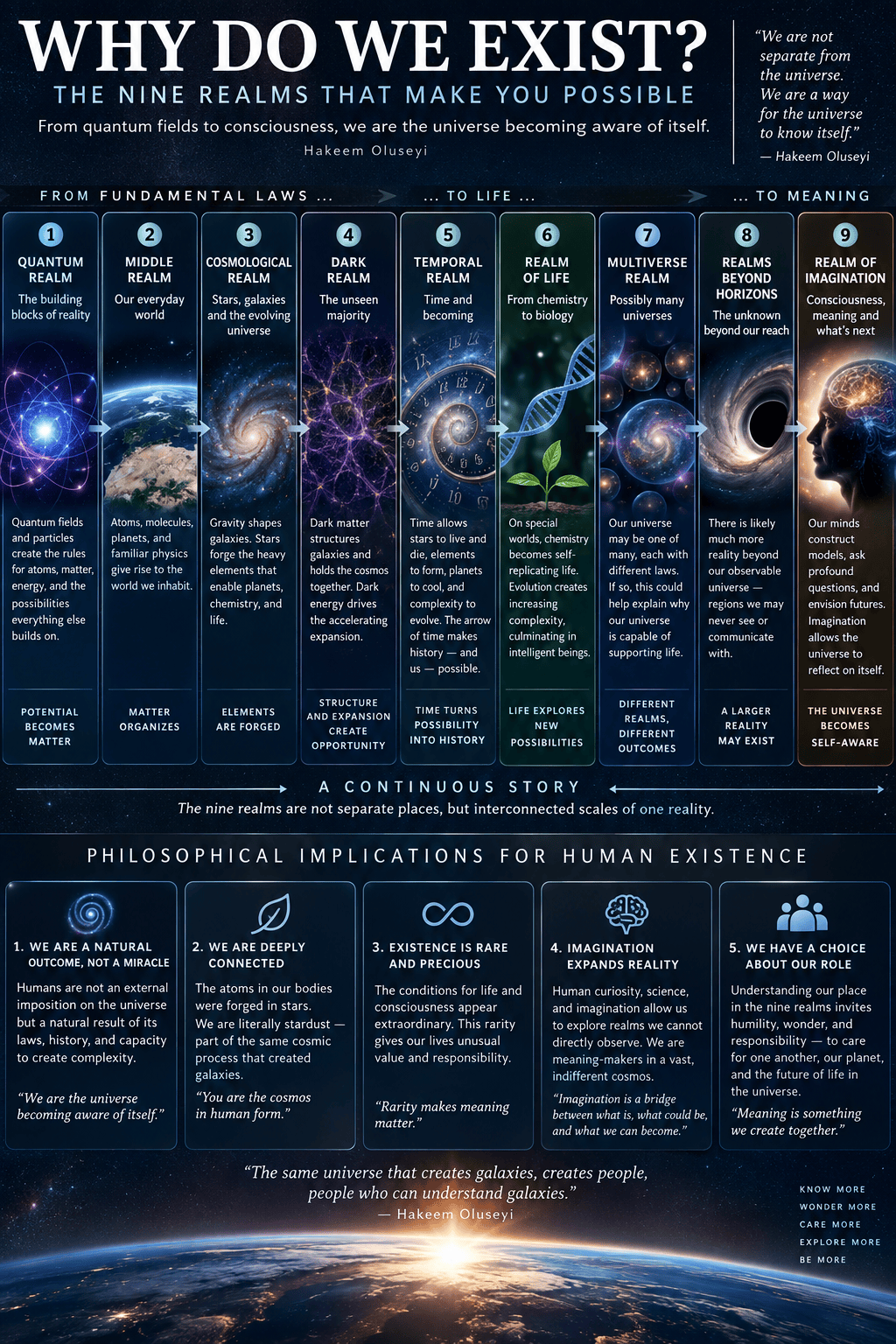
The Nine Realms of Universe that Make You Possible
Book by astrophysicist Hakeem Oluseyi with Nils Johnson-Shelton, published in April 2026.
Oluseyi’s central idea is that human existence becomes comprehensible when reality is viewed at several radically different scales.
The laws governing quarks, people, stars, galaxies, and the universe appear very different, yet they are parts of a single interconnected physical system.
The nine realms are therefore not nine physical locations. They are nine ways of examining reality, moving from everyday human experience outward to increasingly fundamental, enormous, inaccessible, or speculative domains.
The 9 Cosmic Realms
1. Middle Realm
Our everyday world. Humans, planets, objects, gravity, motion, and the classical physics that largely describes ordinary experience. This is the scale our brains evolved to understand intuitively.
2. Realm of Life
Living systems. How ordinary matter became chemistry, self-replicating organisms, evolution, intelligence, and eventually beings capable of asking why they exist.
3. Cosmological Realm
Stars, galaxies and the large-scale universe. Stellar evolution, galaxy formation, gravity, cosmic structure, and how generations of stars manufactured the elements necessary for planets and life.
4. Dark Realm
Dark matter and dark energy. Most of the universe cannot be directly seen. Dark matter helps organize galaxies and large-scale structure, while dark energy is associated with the accelerating expansion of the universe.
5. Quantum Realm
The subatomic foundation of everything. Particles, quantum fields, uncertainty, probability, tunneling and other phenomena that violate our Middle-Realm intuition but ultimately produce atoms, chemistry and us.
6. Temporal Realm
Time itself. The beginning and evolution of cosmic time, relativity, the arrow of time and questions about whether time ultimately has an endpoint.
7. Multiverse Realm
The possibility of universes beyond ours. Oluseyi considers ideas arising from inflation and modern cosmology in which our observable universe might be only one universe among many. This is substantially more speculative than the preceding realms.
8. Realms Beyond Horizons
What we fundamentally cannot observe. The observable universe is limited by horizons created by the finite speed of light and cosmic expansion. Reality may extend enormously beyond what information can ever reach us.
9. Realm of Imagination
The universe as understood by conscious minds. Mathematics, scientific inference, creativity and imagination allow humans to reason about things we cannot directly experience, from quantum fields to the remote future of civilization.
The argument connecting them
The most interesting part of Oluseyi’s framework is that the realms aren’t independent.
You can roughly follow the causal chain:
Quantum fields → particles → atoms → stars → heavy elements → planets → chemistry → life → consciousness → understanding the universe
A carbon atom in your brain, for example, connects several realms. Quantum mechanics determines its atomic structure. Nuclear physics explains how carbon was manufactured inside stars. Cosmology explains how galaxies provided environments in which generations of stars could form. Biology incorporated carbon into living organisms. And eventually some of those organisms developed brains capable of understanding carbon atoms.
That produces one of the book’s deeper themes: we aren’t merely observers placed inside the universe. We are products of the same physical processes we’re trying to understand!
So why do we exist?
Oluseyi does not ultimately answer this as “the universe intended humans to exist.”
It’s closer to:
Given the universe’s laws and history, how did a universe that began in an extraordinarily simple state become complex enough to contain beings capable of asking why they exist?
The answer unfolds across the nine realms.
Quantum physics permits stable matter. Gravity creates stars. Stars manufacture heavier elements. Galaxies provide environments for repeated generations of stars and planets. Chemistry becomes increasingly complex. Somewhere in that process, chemistry becomes biology, biology evolves nervous systems, and nervous systems eventually produce consciousness.
The final step is particularly interesting philosophically: the universe has produced creatures capable of constructing mental models of parts of reality they can never directly experience.
That is why Oluseyi ends with Imagination, rather than galaxies or the multiverse.
The most interesting idea
The book reverses the usual perspective.
We normally think:
Human → Earth → Solar System → Galaxy → Universe
Oluseyi asks us to think in the opposite direction:
Universe → galaxies → stars → elements → planets → life → consciousness → you
Seen this way, a human being is not something separate from cosmology. You are one temporary configuration of matter and energy produced by roughly 13.8 billion years of cosmic evolution.
And yet that configuration has acquired an unusual capability: the ability to reconstruct the history that produced it.
That intersection of cosmology and consciousness is really what Why Do We Exist? is about.
Philosophical implications
1. We are not in the universe. We are of the universe.
This is the conceptual shift I find most powerful.
We normally picture ourselves as observers:
Me → looking at → Universe
Physics gives us a different picture:
Universe → stars → elements → planets → chemistry → biology → nervous systems → consciousness
Every carbon atom in your brain and calcium atom in your bones has a cosmic history. The distinction between “you” and “the universe” is therefore useful at the human scale, but not fundamental.
Philosophically, this undermines the intuition that humans somehow stand outside nature.
We are nature examining nature.
That statement does not require mysticism. It follows from ordinary physical continuity.
2. Consciousness creates a remarkable cosmic feedback loop
Consider what happened over roughly 13.8 billion years:
Energy → matter → stars → heavy elements → complex chemistry → life → brains → self-awareness
Then something unusual occurs.
A brain made from those elements develops mathematics and builds telescopes. It looks outward and reconstructs events billions of years before that brain existed.
So the causal chain effectively loops back:
Universe → consciousness → understanding of universe
This does not demonstrate that consciousness was the universe’s purpose. Physics gives us no evidence that the universe was trying to produce observers.
But consciousness introduces something genuinely new at our level of description: the universe contains systems capable of constructing models of the universe itself.
That is extraordinary without requiring anything supernatural.
3. The anthropic principle changes the question
There’s an apparent puzzle.
Why do the laws and constants of physics permit stars, carbon chemistry, planets and ultimately observers?
One response is the anthropic principle:
We necessarily observe a universe compatible with observers because otherwise nobody would be here to observe it.
That’s logically sound but emotionally unsatisfying. It doesn’t explain why such a universe exists.
This leaves several possibilities:
Necessity: perhaps deeper physics eventually shows that the constants could not have been otherwise.
Chance: perhaps our universe simply happens to have life-compatible conditions.
Selection: if many universes with different properties exist, observers naturally appear only in the subset permitting complexity.
Purpose: some philosophical or theological interpretations infer intentionality.
Science currently cannot choose decisively among all of these. The multiverse is especially important to Oluseyi’s framework because it potentially transforms apparent fine-tuning from an extraordinary coincidence into a selection effect.
4. Cosmic insignificance and human significance aren’t opposites
Astronomy repeatedly displaced humanity from privileged physical locations (the Blue Dot 🔵)
Earth isn’t the center of the Solar System.
The Sun isn’t the center of the galaxy.
The Milky Way isn’t the center of the universe.
Humans appeared extremely late in cosmic history.
It’s tempting to conclude:
We are tiny → therefore we are insignificant.
That conclusion doesn’t follow.
Physical size has no obvious relationship to value.
A human brain weighs about three pounds. A star can outweigh it by 10³⁰ times. Yet the star doesn’t know it exists.
Significance belongs to a different category than mass, distance or luminosity.
That distinction matters enormously.
Cosmology can tell us how small we are. It cannot tell us how much a human life is worth.
5. A universe without predetermined meaning needn’t be meaningless
Suppose, for argument’s sake, that physics eventually provides a completely naturalistic explanation for human existence.
There is no cosmic plan.
No predetermined purpose.
No destination toward which the universe is moving.
One might then conclude:
Then nothing matters.
But that’s a philosophical claim, not a scientific conclusion.
There’s another possibility:
Meaning isn’t something the universe gives us. Meaning is something conscious beings create.
Love matters because conscious creatures experience love.
Suffering matters because conscious creatures suffer.
Beauty matters because minds experience beauty.
Knowledge matters because minds can understand.
Your relationships with children, grandchildren, friends and strangers need not affect galaxy formation to be meaningful.
Meaning exists at the scale where conscious experience exists.
6. Mortality may increase rather than diminish meaning
Cosmology is merciless about impermanence.
People die.
Species disappear.
Stars exhaust their fuel.
Galaxies evolve.
Even the long-term future of the universe may eventually become incapable of sustaining the complexity familiar to us.
One response is nihilism:
If everything eventually disappears, nothing matters.
But the opposite conclusion is equally possible:
Things matter partly because they don’t last.
A sunset isn’t worthless because it lasts ten minutes.
A symphony isn’t meaningless because it ends.
A human life need not be infinite to be valuable.
In fact, unlimited time might make choices less consequential. Scarcity forces prioritization.
Mortality therefore creates something important: urgency.
7. Knowledge expands the boundaries of human existence
Oluseyi’s Realm of Imagination becomes particularly interesting here.
Your body occupies perhaps two meters of space and roughly a century of time.
Your mind doesn’t.
You can contemplate the first fractions of a second after the Big Bang.
You can imagine galaxies whose light traveled billions of years before reaching us.
You can model events trillions of years in the future.
You can contemplate universes that may never be observable.
So humans possess a peculiar ability:
We can mentally inhabit realities we can never physically visit.
Science is therefore more than accumulating facts. It extends the effective range of human experience.
8. Meaning may ultimately become an ethical question
Once consciousness exists, another transition occurs.
Matter can now affect the welfare of other conscious matter.
A star can’t decide whether another star suffers.
We can.
That means consciousness introduces responsibility.
And this produces what I think is the deepest implication of Oluseyi’s journey:
Quantum physics makes matter possible. Cosmology makes complexity possible. Biology makes consciousness possible. Consciousness makes choice possible. Choice makes responsibility possible.
Physics gets us remarkably far. And physics cannot tell us what we ought to do with the existence it has made possible.
So Why am I Here?
Cosmology suggests asking two questions.
The first is scientific:
How did the universe become capable of producing me?
We have increasingly sophisticated answers to that.
The second is philosophical:
Given the astonishing fact that I am here, what should I do with the finite period during which I am conscious?
Science cannot answer that one for us.
But the nine-realms perspective suggests a compelling framework:
Understand more. Experience more. Love more. Reduce unnecessary suffering. Create things that outlast you. Help future conscious beings inherit better possibilities.
There is an interesting inversion here. We often search the cosmos hoping to discover evidence that human existence has meaning. Perhaps meaning only enters the cosmic story when creatures capable of valuing things appear.
In that interpretation, humans aren’t the center of the universe and neither are we irrelevant.
For the brief period that consciousness exists, we are among the places where an otherwise largely unconscious universe can experience itself, understand its past, and imagine its future.
Startalk Podcast with author interview
NB: This post written with the assistance of ChatGPT.
 Dr Bob, Brain Mechanic