
Warning: Most of this is not clearly backed by medical science and should be looked at with a critical eye. There clearly appear to be issues with anecdotal evidence, placebo response and the entrepreneurial aspect of the Biohacking Brother’s recommendations. Miguel and Carlos Bertonatti, also known as the “Biohacking Brothers,” are health optimization entrepreneurs andContinueContinue reading “The Biohacking Brothers: Legit or Snake Oil Salesmen?”
Tag Archives: longevity
Major Study on Physical activity types, variety, and mortality (longevity)
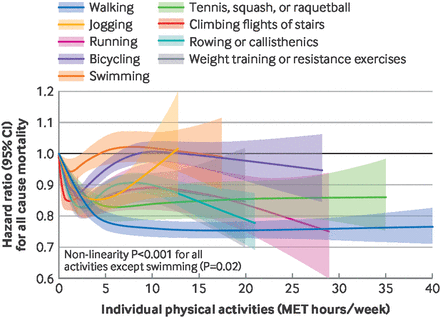
TL:DR Variation in physical activity may be just as important as total activity to promote longevity This study used long-term data from two large prospective cohort studies, the Nurses’ Health Study and the Health Professionals Follow-Up Study, including over 110,000 adults followed for up to ~30+ years to look at the relationship between types ofContinueContinue reading “Major Study on Physical activity types, variety, and mortality (longevity)”
Rethinking “high HRV”
If you want to increase your HRV, start by forgetting about chasing a big number and focus instead on building a steady, low‑noise baseline. – Many people want higher HRV because they think it proves elite athleticism, but research shows the link is loose and highly individual. – What often separates “high HRV” athletesContinueContinue reading “Rethinking “high HRV””
The immune system offers a window into aging
“The immune system permeates and regulates organs and tissues across the body, and has diverse roles beyond pathogen control, including in development, tissue homeostasis and repair. The reshaping of the immune system that occurs during aging is therefore highly consequential. In this Focus issue, Nature Aging presents a collection of reviews of and opinions onContinueContinue reading “The immune system offers a window into aging”
Nicotinamide Riboside vs. Nicotinamide Mononucleotide
Which NAD⁺ Booster Is Right for You? In recent years, two vitamin B3 derivatives—Nicotinamide Riboside (NR) and Nicotinamide Mononucleotide (NMN)—have emerged as leading contenders in the world of longevity science. Both are precursors to NAD⁺ (nicotinamide adenine dinucleotide), a coenzyme essential for energy production, DNA repair, and healthy cell function. As we age, NAD⁺ levelsContinueContinue reading “Nicotinamide Riboside vs. Nicotinamide Mononucleotide”
Is Sulforaphane ‘Neuroprotective’?
Recently, the protective effects of sulforaphane on brain health were also considerably studied, where the studies have further extended to several neurological diseases, including Alzheimer’s disease (AD), Parkinson’s disease, Huntington’s disease, amyotrophic lateral sclerosis, multiple sclerosis, autism spectrum disorder, and schizophrenia. Animal and cell studies that employ sulforaphane against memory impairment and AD-related pre-clinical biomarkersContinueContinue reading “Is Sulforaphane ‘Neuroprotective’?”
 Dr Bob, Brain Mechanic